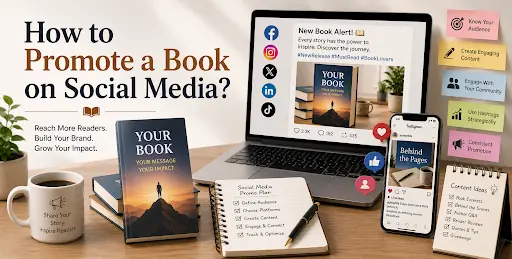
Promoting a book on social media works best when you pick 2–3 platforms where your readers already spend time, mix genuine engagement with promotional content at roughly an 80/20 ratio, and use short-form video (especially TikTok’s BookTok community) alongside targeted Facebook and Instagram ads to reach readers beyond your existing followers.
Authors who treat social media as a long-term relationship with readers not a launch-week consistently see stronger, more lasting book sales.
The rest of this guide breaks down exactly how to do that, platform by platform, with real data on what’s working right now.
This guide draws on current platform data from Pew Research Center, publishing industry reporting, and hands-on author-marketing experience at Bookstone Publishers.
Why Social Media Still Matters for Book Sales
It’s easy to feel like social media is oversaturated. It isn’t, it’s just gotten more specific. According to Pew Research Center’s most recent national survey of U.S. adults, YouTube remains the most widely used platform at 84% adoption, followed by Facebook at 71% and Instagram at 50%, while TikTok has grown to 37% of U.S. adults, with usage up sharply among younger readers (Pew Research Center, 2025). That’s not a reason to be on every platform. It’s a reason to be deliberate about which one matches your genre and audience.
Book-specific data backs this up. Publishers Weekly has reported that BookTok-driven content contributed to nearly 59 million print book sales in a single year, with previously midlist and backlist titles climbing bestseller lists purely from short-form video discovery. That’s a meaningful shift from a decade ago, when author social media strategy mostly meant Facebook status updates and the occasional tweet.
For authors, the practical takeaway is this: social media book promotion isn’t about broadcasting “buy my book” as often as possible. It’s about being visible in the specific corners of the internet where your readers are already discussing books like yours then giving them an easy, low-friction way to find and buy your book once they’re interested.
Book Promotion Ideas for Social Media That Actually Work
Most experienced author-marketers point to the “80/20 rule”. Roughly 80% of your posts should be genuinely useful, entertaining, or personal, and only about 20% should be direct promotion of your book. Readers follow authors because they’re curious about the person and the story world, not because they want a running stream of purchase links.
Here are book promotion ideas for social media that consistently perform well across genres:
Behind-the-scenes writing content
Show your desk, your outline process, a deleted scene, or the moment you got your first review. Readers are drawn to the human side of authorship.
Character and world-building reveals
Especially effective for fiction. A moodboard, a “casting” post, or a map of your fictional setting invites shares and comments.
Short readable excerpts
A single striking line or paragraph, posted as a quote graphic, gives readers a taste without asking for a purchase.
Reader-generated content
Reposting reviews, fan art, or reading photos (with permission) builds community and gives you free content.
Question-based posts
Ask followers about tropes they love, plot twists they didn’t see coming, or which character they’d want to meet. Questions drive comments, and comments drive reach.
Milestone posts
Cover reveals, pre-order announcements, and launch-day posts are the moments worth turning into your “20%” and even paying to boost.
Trend participation
On TikTok and Reels, using a trending sound or format with a book-related twist can put your content in front of people who’ve never heard of you.
These book promotion ideas work across almost every platform, but how you execute them should shift depending on where you’re posting.
| Platform | Best For | Content Type | Time Investment | Free or Paid |
| TikTok (BookTok) | Fiction, especially romance, fantasy, YA, thriller | Short-form video, trends, hooks | High (frequent posting) | Both — strong organic reach |
| Visual authors, all genres | Photos, Reels, Stories, quote graphics | Medium | Both | |
| Nonfiction, established fanbases, older readers | Groups, updates, live video | Medium | Best used with paid ads | |
| Discoverability over time | Pins linking to book pages | Low once set up | Mostly free | |
| YouTube | Long-form connection, author platform-building | Vlogs, readings, interviews | High | Mostly free |
| Threads/X | Quick updates, industry conversation | Short text posts | Low-Medium | Mostly free |
Platform-by-Platform Breakdown
A useful rule of thumb: pick the platform your ideal reader already uses to talk about books, not the platform you personally enjoy most. A thriller author might get far more traction on a Facebook readers’ group than on TikTok, while a YA fantasy author will likely find the opposite is true.
Promoting a book on social media isn’t about mastering every platform. It’s about consistently showing up on the one or two where your actual readers are, with content that gives them a reason to care before you ask them to buy. Whether you handle it yourself, bring on a social media manager for authors, or partner with a social media marketing company for authors like Bookstone Publishers, the underlying principle stays the same: build the relationship first, and the sales tend to follow.
BookTok and TikTok: Why Fiction Authors Can’t Skip It?
If your book is fiction, particularly romance, fantasy, YA, or psychological thriller; TikTok deserves a disproportionate share of your attention. The genres that consistently generate the strongest BookTok engagement are romance, fantasy, psychological thrillers, dystopian fiction, dark academia, and young adult novels, largely because these stories lend themselves to emotional, shareable hooks.
The mechanics of a good BookTok video are different from a typical promotional post. Rather than explaining the plot, successful videos open with a hook in the first few seconds. A dramatic line, a surprising twist, or an emotional confession that makes a scrolling viewer stop. Authors who see consistent long-term results tend to treat their TikTok presence as an ongoing relationship with readers rather than a tool they activate only around a launch. They post between books, comment on other authors’ content, and participate in genre conversations that aren’t directly about their own work.
This is where paid promotion can extend your reach without replacing the organic strategy. Boosting a video that’s already performing well organically rather than creating an ad from scratch tends to feel more native to the platform and convert better than a traditional advertisement.
Facebook and Instagram Ads for Authors: When and How to Use Them
Organic reach on Facebook has declined significantly over the years, which is why Facebook and Instagram ads for authors have become one of the more reliable ways to reach readers who don’t already follow you. Meta’s advertising platform allows authors to target by interests (favorite authors, genres, book clubs), demographics, and even lookalike audiences based on existing readers or newsletter subscribers.
A few principles make Facebook and Instagram ads for authors more effective:
Send traffic to a single, clear destination
A book landing page with purchase links across retailers, not just your homepage.
Test creative before scaling spend
Run two or three ad variations (different cover images, different hooks in the copy) with a small budget first, then put more money behind whichever performs best.
Retarget engaged readers
Someone who watched 50% of your book trailer or visited your landing page without buying is a warmer audience than a cold interest-based one, retarget them separately.
Time ads around momentum, not just launch day.
A well-timed ad push around a price drop, an award nomination, or a positive review can outperform launch-week ads that compete with dozens of other new releases.
Authors with limited time or ad experience often reach a point where DIY campaigns stop scaling. This is usually when working with a social media manager for authors, or a broader social media marketing company for authors, starts to make financial sense. Someone dedicated to monitoring ad performance daily can typically stretch a budget further than an author managing campaigns in spare moments between writing sessions.
Free vs. Paid Promotion: Building a Balanced Strategy
Not every author has an ad budget, and that’s fine. A strong organic foundation should come first regardless.
Free social media book promotion tactics include:
- Creating consistent author profiles across 2–3 platforms with a clear bio and link to your book.
- Joining reader communities on Facebook, Goodreads, and Reddit where genre discussion is welcome.
- Partnering with book bloggers and micro-influencers in exchange for honest reviews.
- Hosting live Q&As or readings.
- Cross-promoting with other authors in your genre through joint giveaways or shoutouts
- Paid tactics: Facebook and Instagram ads for authors, boosted TikTok videos, and Amazon Marketing Services work best once you already have some organic traction and know which content resonates. Paid spend amplifies what’s already working; it rarely fixes content that isn’t landing organically.
At Bookstone Publishers, we typically advise authors to spend their first few months building organic engagement and only introduce paid ads once they have a clear sense of which posts, hooks, and platforms their specific readers respond to. Publishing houses like Bookstone Publishers often see better ad performance from clients who’ve already tested creative organically, simply because there’s real data to work from before spending a dollar.
DIY, a Social Media Manager for Authors, or a Full Marketing Agency?
Authors generally have three paths for handling book promotion on social media:
Doing it yourself
Works well for authors who enjoy the process and have time to post consistently. Ideally several times a week per platform. It’s the lowest-cost option but the most time-intensive.
Hiring a social media manager for authors
Makes sense once posting consistency starts slipping, or once you’re ready to run paid campaigns but don’t have the bandwidth to test and optimize them. A dedicated manager can handle content calendars, respond to comments, and track which posts convert to sales.
Working with a social media marketing company for authors
An agency or a publisher-affiliated marketing team is typically the right move for authors juggling multiple books, larger ad budgets, or a launch with many moving parts (press, events, ads, and organic content all at once). Bookstone Publishers offers this kind of integrated support for its authors, coordinating organic content and paid Facebook and Instagram ad campaigns around each book’s launch timeline rather than treating social media as an afterthought.
There’s no universally “correct” choice here. It depends on your budget, your available time, and how many books you’re actively promoting at once.
A Simple 30-Day Social Media Launch Framework
If you’re unsure where to start, here’s a straightforward cadence to build momentum in the weeks before and after a launch
Weeks 1–2 (pre-launch): Post behind-the-scenes content, share your cover, and start a countdown. Ask followers questions related to your book’s themes.
Week 3 (launch week): Share the release announcement across every platform you use, post a short video reading or trailer, and consider a small ad budget behind your best-performing pre-launch content.
Week 4 (post-launch): Repost early reader reviews, host a live Q&A, and start planning your next content cycle. Momentum built in week 4 often outperforms launch day itself, since word-of-mouth and reviews are just starting to appear.
The key is not stopping after launch week. Authors who keep posting consistently for months afterward tend to see steadier, longer sales curves than those who go quiet once the initial push ends.
How to Measure Whether Your Social Media Strategy Is Working
It’s easy to chase vanity metrics, follower counts feel good, but they don’t pay royalties. A more useful set of numbers to track includes:
Click-through rate to your book page
If a post has strong likes but almost no link clicks, the content is entertaining but not converting.
Saves and shares, not just likes
On both Instagram and TikTok, saves and shares tend to signal that the platform’s algorithm will show your content to more people, since they indicate a viewer found it valuable enough to revisit or pass along.
Engagement rate relative to follower count
Not raw numbers. An account with 2,000 highly engaged followers in a niche genre community can outsell an account with 20,000 passive followers.
Conversion from ad spend to actual sales
tracked through retailer-specific promo links or affiliate tracking where available. This is the number that ultimately tells you whether Facebook and Instagram ads for authors are worth continuing.
Most social media platforms provide native analytics dashboards that cover the basics for free. Authors working with a social media manager for authors typically get a more detailed monthly breakdown, since a dedicated manager can compare performance across platforms and adjust the content calendar accordingly, rather than reacting only after a launch has already happened.
It’s also worth revisiting your strategy every few months rather than setting it once and leaving it alone. Platform algorithms change often what worked on Instagram a year ago may perform very differently today, so the authors who sustain long-term sales tend to be the ones willing to adjust their content mix as the data comes in.
Common Mistakes Authors Make on Social Media
A few patterns show up repeatedly among authors whose social media book promotion efforts stall:
Posting only when there’s something to sell
Followers notice when an account goes quiet for months and then suddenly reappears with a purchase link.
Spreading effort too thin across too many platforms
Trying to maintain five accounts often means all five suffer, compared to doing genuinely well on two.
Ignoring comments and messages
Social media rewards two-way engagement; accounts that never respond tend to see decline over time.
Treating every post as an ad
This is the fastest way to violate the 80/20 rule and lose followers’ attention.
Giving up too early
Most organic growth on social media compounds slowly, and authors who quit after a few weeks of modest results often stop right before momentum would have built.
Avoiding these pitfalls is often simpler than finding brand-new tactics. Consistency and genuine engagement tend to outperform cleverness.
Frequently Asked Questions
What is the best social media platform to promote a book?
It depends on your genre. Fiction authors, especially in romance, fantasy, and YA, often see the strongest results on TikTok. Nonfiction authors and those with established, slightly older audiences frequently do better on Facebook.
How often should authors post on social media?
Most successful author accounts post at least 3–5 times a week on their primary platform, though quality and consistency matter more than sheer volume.
Is TikTok worth it for authors?
For fiction authors in particular, yes. BookTok has become one of the strongest book-discovery engines currently active, and organic reach there is still stronger than on more saturated platforms.
How do you promote a book on social media for free?
Focus on consistent posting, genuine engagement in reader communities, partnerships with book bloggers or micro-influencers, and cross-promotion with other authors, all before spending on ads.
Should authors run paid ads for their book?
Once you have some organic traction and know what content performs, Facebook and Instagram ads for authors can meaningfully extend your reach. It’s generally best to test creative with a small budget before scaling spend.
What’s the 80/20 rule in book marketing?
Roughly 80% of your content should be genuinely engaging or personal, with only about 20% directly promotional. This keeps followers interested rather than feeling constantly sold to.