
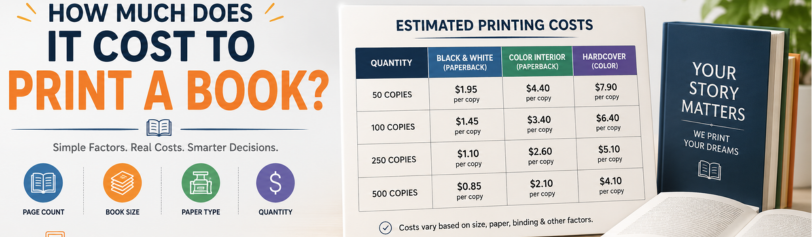
Book printing costs usually fall between two dollars and twenty dollars per copy, depending on binding type, page count, interior color, paper stock, and order size. A short run black and white paperback often costs two to seven dollars per copy, while a hardcover with a dust jacket can run ten to twenty dollars per copy at low volume, dropping well below that once you order in bulk.
Every author eventually asks the same question once the manuscript is finished: What will it actually cost to hold a printed copy of this book in your hands? The honest answer is that book printing costs depend on more variables than most people expect, and a number pulled from one printer’s website will not necessarily match what you pay somewhere else. Working with professional book printing services can also help authors compare these variables and choose the most cost-effective production option.
This guide breaks down exactly what drives the cost of printing a book, walks through real numbers from Amazon’s own publishing platform, and compares the three main ways books get printed today so you can budget with confidence instead of guessing.
What Actually Determines Book Printing Cost
The cost of printing a book is not one flat number. It is the sum of several separate decisions, each one adding or subtracting from your final price per copy.
Amazon’s own Kindle Direct Publishing platform, one of the largest print on demand services in the world, explains its cost model plainly. According to KDP’s official documentation, printing cost is calculated by adding a fixed cost to your page count multiplied by a per page rate, and “bleed settings and cover finish don’t affect printing cost” under their specific model, though that is not true of every printer.
That single formula, fixed cost plus page count times per page rate, is close to how most printers price a book, even if the exact numbers differ from company to company. Understanding the pieces behind that formula is what actually helps you plan.
| Cost Factor | How It Affects Price |
| Page count | More pages means more paper and ink, so cost rises with length |
| Trim size | Larger page dimensions use more material per copy |
| Binding type | Paperback is cheapest, hardcover with a jacket costs noticeably more |
| Interior color | Black and white is far cheaper than full color interior pages |
| Paper stock | Heavier or premium paper raises cost per page |
| Print quantity | Cost per copy drops sharply as order size grows |
| Cover finish | Gloss or matte lamination and jackets add a small per copy fee |
Trim size, the physical dimensions of the finished book, plays a bigger role than most first time authors expect. A standard 5.5 by 8.5 inch paperback costs less to produce than an 8.5 by 11 inch book, simply because a larger page uses more paper and more ink per copy.
Average Book Printing Cost by Type
Real numbers are more useful than vague ranges, so here is what typical costs look like across common book formats, based on published pricing from major print on demand platforms and short run printers.
| Book Type | Typical Cost Per Copy | Order Size |
| Paperback, B/W interior | $2 to $7 | Short run or POD |
| Paperback, color interior | $6 to $15 | Short run or POD |
| Hardcover, B/W interior | $8 to $15 | Short run or POD |
| Hardcover with jacket | $10 to $20 | Short run or POD |
| Bulk offset run | Under $2 | 1,000+ copies |
An example using Amazon KDP’s own calculator for a 300 page black ink paperback, the math comes out to one dollar in fixed cost plus 300 pages multiplied by just over one cent per page, landing at roughly four dollars and sixty cents per copy printed.
Hardcover pricing follows the same structure but starts from a much higher fixed cost. Amazon’s help documentation for hardcover printing gives an example of a 300 page hardcover book in the same black ink format, which comes out to about nine dollars and twenty five cents per copy, more than double the paperback price for the identical page count.
That gap between paperback and hardcover is the single biggest binding decision you will make, and it is worth understanding before you commit to a format.
Cost to Print a Hardcover Book Versus Paperback
Hardcover books cost more to print for a simple reason. The binding process itself requires more materials and more labor. A paperback uses a flexible cover glued or sewn to the pages, while a hardcover needs rigid board covers, cloth or paper wrapping, and often a separate printed dust jacket, each one adding its own cost layer.
As a rough guideline, expect hardcover printing to run somewhere between eight and twenty dollars per copy at low volume, compared with two to fifteen dollars for paperback depending on interior color. If you are choosing between formats purely on cost, paperback wins for a first print run, while hardcover makes more sense once you have proven demand and can justify the higher retail price it usually commands.
Understanding Book Binding Cost
Binding cost is often lumped into the overall printing price, but it deserves its own look since it varies more than people expect between formats.
- Saddle stitch, stapled booklets, is the cheapest option and works only for very short page counts
- Perfect binding, the standard glued paperback spine, is the most common and cost effective choice for novels
- Case binding, true hardcover with rigid boards, costs the most but produces the most durable finished book
- Spiral or coil binding sits in the middle and suits workbooks or manuals more than fiction
For most authors printing a novel or general nonfiction title, perfect binding on a paperback offers the best balance between cost and a professional finished look.
Print on Demand Versus Short Run and Offset Printing
How you print your book changes the cost curve entirely, not just the price per copy. There are three main paths, and each one suits a different stage of a book’s life.
| Print on Demand | Short Run Digital | Offset Printing | |
| Best for | Testing a book, low volume | 50 to 1,000 copies | 1,000+ copies |
| Cost per copy | Highest per unit | Moderate, drops with volume | Lowest per unit at scale |
| Upfront cost | None | Small setup fee | Higher setup and plate cost |
| Inventory risk | None, prints per order | Low, small batches | Higher, must store stock |
Print on demand, the model behind Amazon KDP and IngramSpark, prints and ships a single copy only after someone orders it. There is no inventory to store and no upfront cost, which makes it the safest starting point for a first time author, even though the per copy price is the highest of the three methods.
Short run digital printing sits in the middle, letting you order a batch of fifty to a thousand copies at a lower per unit cost than POD, useful once you know your book sells and want author copies on hand for events or bulk orders.
Offset printing becomes worthwhile once you are ordering a thousand copies or more. The setup cost is higher, but the per copy price drops well under two dollars at real scale, which is how traditional publishers keep their unit costs so low on bestsellers.
Self Publishing Cost Versus Traditional Publishing
One point of confusion worth clearing up early: if you are traditionally published, you typically never pay a printing bill yourself. The publishing house covers production costs and pays you a royalty instead. Printing cost only becomes your direct expense once you are self-publishing, whether through a print-on-demand platform or by ordering copies from a printer to sell or distribute yourself. This distinction is important when calculating the cost to publish a book, because printing is only one part of the overall publishing budget.
This is exactly why self published authors need to understand printing costs so closely. Every dollar spent on production comes directly out of your margin, so the format and printer you choose has a real effect on what you take home per sale.
Hidden Costs Worth Budgeting For
- Proof copies, either digital or physical, to check quality before a full print run
- Shipping, which scales with order size but rarely disappears entirely even at high volume
- Rush production fees if you need books faster than standard turnaround
- File formatting or design fixes if your manuscript is not already print ready
None of these costs are hidden in a dishonest sense. They are simply easy to forget when you are focused only on the per copy printing number, and they can add up to a meaningful portion of your total budget if you do not plan for them.
There is no single correct answer to what it costs to print a book, because the honest answer depends entirely on the choices you make along the way. Page count, binding, interior color, paper, and quantity all pull the number in different directions, and the right combination depends on your budget and your goals for the book.
At Bookstone Publishers, this is exactly the kind of decision we walk authors through before a single page goes to print, matching format and print method to the book and the budget rather than defaulting to whichever option is easiest to sell. If you want a clear, specific number for your own manuscript rather than a general range, our team can walk you through it.
Frequently Asked Questions
How much does it cost to print a book on average?
Most short run paperbacks cost between two and seven dollars per copy to print, while hardcover books typically run eight to twenty dollars per copy depending on page count and finish.
What is the cheapest way to print a book?
A black and white paperback printed through print on demand is generally the cheapest option for a first run, since there is no upfront cost and no inventory to store.
Does printing more copies lower the cost per book?
Yes. Printing cost per copy drops as quantity increases, since fixed setup costs get spread across more units, and the effect becomes dramatic once you reach offset printing volumes.
How much more does a hardcover cost to print than a paperback?
Hardcover printing typically costs two to three times more per copy than paperback for the same page count, mainly due to the rigid binding and dust jacket.
What factors affect book printing cost the most?
Page count, interior color, binding type, and print quantity have the biggest impact, with color interiors and hardcover binding adding the most cost per copy.
Can I get an exact price before I print?
Yes. Most printers and print on demand platforms, including Amazon KDP, offer a free calculator that gives an exact per copy price once you enter your book’s specifications.
Is print on demand more expensive than ordering in bulk?
Per copy, yes. Print on demand carries the highest per unit cost of the three main printing methods, but it also requires no upfront investment or inventory risk