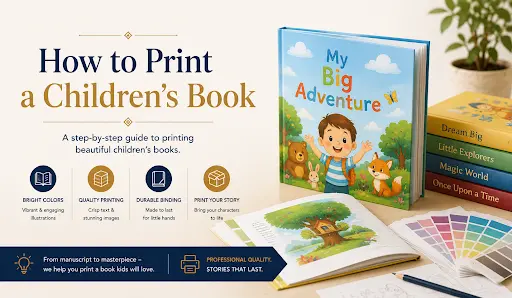
Printing a children’s book comes down to a handful of decisions: trim size, binding type (paperback, hardcover, or board book), and print method (print on demand or offset), all while meeting page count and safety rules. Most picture books land on an 8.5 by 8.5 inch square or 8.5 by 11 inch trim, run 24 to 40 pages, and cost anywhere from a few dollars a copy through print on demand to under two dollars a copy, once you’re printing in bulk.
Every children’s book author hits the same wall eventually. The story’s done, the art is finished, and now you’re staring at a pile of decisions nobody warned you about. Trim size. Paper weight. Which binding. What font even works for a five-year-old learning to read. And somewhere in there, whether your book meets basic safety rules at all. Professional book printing services can help with these technical choices, but knowing what to expect makes the process much easier. This guide walks through children’s book printing in the order you’ll actually run into these questions, so you’re not guessing your way through it.
Why Children’s Book Printing Isn’t Like Printing a Nove
Printing a children’s book is its own animal, honestly. A novel lives or dies on the text. A picture book lives or dies on how the illustrations hit the page, which means paper quality and color accuracy suddenly matter a lot more than they would for a paperback thriller. Page counts run shorter too, trim sizes run bigger, and the binding often needs to survive a toddler treating it like a chew toy.
Trim size is usually where everyone starts, and for good reason. One formatting guide put it plainly: “choosing your trim size is the first and most consequential formatting decision you will make,” since your page count, your margins, even your spine width all flow from that one choice. Get this part wrong and you’ll be redoing work you thought was finished.
Dimensions of Children’s Books: What Size Should You Actually Pick
The dimensions of children’s books are more standardized than you’d think, and sticking close to the common sizes keeps your options open later. Square trims like 8.5 by 8.5 inches are everywhere in picture books, partly because they suit balanced illustrations and partly because they just feel right in small hands. If your book leans more text heavy, a portrait trim like 8.5 by 11 inches tends to work better.
Amazon’s own KDP support community has confirmed that 8.5 inches is the platform’s maximum print width, and that the 8.5 by 8.5 inch square is one of the most common trims authors choose for print on demand children’s books. One practical thing worth checking early: not every trim size is available across every binding type, so if you’re planning both a paperback and a hardcover version, confirm your size works for both before you lock anything in.
Children’s Book Fonts That Actually Help Young Readers
Font choice carries more weight here than in almost any other kind of book, since a lot of your readers are still learning what letters look like. Children’s book fonts should stay simple, rounded, and generously spaced. Save anything decorative or stylized for the cover or the title, and keep the actual story text as plain and legible as you can manage.
Size matters just as much as style. A book aimed at toddlers usually needs a bigger type than one aimed at a seven year old, simply because younger kids are still building the visual skills to track smaller text across a page. Whatever font you land on, print an actual proof and read it at real size before you approve anything. Fonts that look fine on a screen don’t always hold up on paper.
The Page Count Rules Nobody Tells You About Upfront
Page count isn’t just a creative choice in children’s book printing, it’s a technical one. Offset printed books generally need a page count divisible by four, since pages get printed on large sheets and folded down into sections. Board books and spiral bound formats are more forgiving, usually only needing to divide by two.
KDP’s contributor community has laid out specific minimums too: 72 pages for standard color paperbacks, 24 for premium color, and 75 for hardcover. Most picture books end up somewhere between 32 and 40 pages once you count the title page, copyright page, and any dedication pages. Worth planning your story length around that early, rather than finding out after the fact that you’re a few pages short of what your printer requires.
Hardcover Children’s Book Printing Versus Paperback
Hardcover children’s book printing gets you a sturdier, more gift ready book, but it’s not without tradeoffs. You’re looking at rigid board covers, often wrapped in printed paper or cloth, sometimes a separate dust jacket on top of that, and each of those pieces adds cost and time to production.
Paperback is still the easier entry point for most first time authors. It costs less per copy and pretty much every print on demand platform supports it without restriction. Hardcover starts making more sense once a book has actually proven itself, since the higher price it commands at retail can offset what it costs to produce. One thing to double check either way: some platforms support square trims in paperback but not in hardcover, so confirm your exact combination is actually available before you finalize files.
Board Books and the Safety Rules You Can’t Skip
If you’re printing for very young kids, safety compliance adds a layer that a picture book for a five year old doesn’t have to deal with. The Consumer Product Safety Commission draws a clear line here. According to the CPSC, an “ordinary book,” meaning one printed on paper or cardboard and bound conventionally, is exempt from third party lead testing. But that exemption specifically leaves out books with play value and anything intended for kids three and under.
What that means in plain terms: your standard picture book for an older child is treated very differently under federal rules than a board book with flaps, textures, or built-in toys made for a toddler. If you’re printing that kind of interactive board book, talk to your printer about testing and certification before you commit to a full run. This isn’t a corner worth cutting or guessing on
Print on Demand Versus Offset Printing for Picture Books
How you print changes both your cost and your flexibility, sometimes more than people expect. Print on demand only prints and ships a copy once someone actually buys it, so there’s no inventory sitting in your garage and no upfront gamble. The tradeoff is a higher per copy cost than you’d get from a bulk run.
Offset printing starts paying off once you’re confident enough to order several hundred copies or more. The per copy price drops noticeably at that scale, though now you’re storing physical books until they sell. A lot of independent children’s book authors split the difference, testing a title through print on demand first and only committing to an offset run once they can see the book actually selling.
What It Really Costs to Print Your Own Children’s Book
If you’re planning to print your own children’s book without a full service partner handling it, budget with the understanding that children’s books just cost more per copy than a plain text paperback of the same length. Full color pages, heavier paper, and bigger trim sizes all push the number up.
As a rough range, expect a full color picture book through print on demand to land somewhere between a few dollars and around ten dollars a copy, depending on page count and trim size, with hardcover running higher on top of that. Order several hundred copies through offset printing and that per copy cost can drop well below the print on demand range. That’s part of why so many authors treat their first print on demand run as a test, a way to see if the book sells before committing real money to a bigger print order.
Children’s Book Printing Tips Worth Actually Following
A handful of habits separate an easy printing experience from a frustrating one.
Always order a physical proof before you approve a full run. Colors and image quality read differently on paper than they do on a screen, every time. Build bleed into your files if any illustration touches the edge of the page, since most printers need that extra margin for trimming. Keep your text a safe distance from the inside gutter too, since a tight inner margin has a way of swallowing words once the book is bound. Lock in your page count before you finalize the cover, since spine width depends entirely on how many pages are inside. And check that your trim size is actually available everywhere you plan to sell, since not every size and binding combination is supported on every platform.
Run through that list before you submit files and you’ll usually get a proof back that’s close to perfect the first time, instead of burning a few rounds of expensive revisions figuring it out.
Printing Your Picture Book: Do It Yourself or Bring in a Partner
Printing your picture book can mean going straight through a print on demand platform yourself, hiring a dedicated printer for an offset run, or working with a publishing partner like Bookstone Publishers who handles the whole thing.
Doing it yourself through a print on demand platform gives you the most control and the lowest barrier to getting started, but you’re also the one troubleshooting formatting problems when they come up. Working with an experienced children’s book printing partner costs more but takes a lot of that technical weight off your shoulders, since a good partner catches things like incorrect bleed or an unsupported trim size before they turn into an expensive reprint. At Bookstone Publishers, this is exactly where we spend most of our time with authors, matching format, binding, and print method to the actual book so the printing process supports the story instead of fighting it.
Frequently Asked Questions
What size should a children’s picture book be?
Most picture books use an 8.5 by 8.5 inch square trim or an 8.5 by 11 inch portrait trim, depending on whether the illustrations suit a balanced square layout or something taller and more vertical.
How many pages does a children’s book need?
Illustrated picture books usually run 32 to 40 pages once front matter is included, though exact minimums vary by printer, often requiring a page count divisible by four for offset printing.
Is hardcover or paperback better for a children’s book?
Paperback costs less and works well for a first print run, while hardcover holds up better and reads as higher value, which makes more sense once a title has already proven it sells.
Do children’s books need to pass safety testing?
Standard picture books for older kids are generally exempt from lead testing as ordinary books, but board books and anything with play value aimed at kids three or younger are not exempt and do need testing.
What font should I use for a children’s book?
Stick with simple, rounded, well spaced fonts for the body text, sized for your target age group, and save anything decorative for the cover or title only.
Can I print just one copy of my children’s book?
Yes. Print on demand lets you print a single copy with no minimum order, which makes it easy to test a book before committing to any bulk run.
Is it cheaper to print a children’s book myself or use a printing service?
Printing it yourself through print on demand is usually cheaper per copy at low volume, while a dedicated printer or offset run pays off once you’re ordering in bulk.