
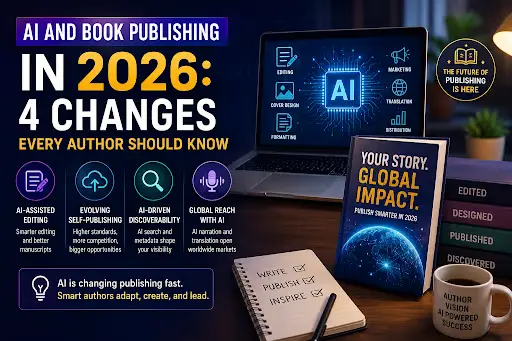
The publishing industry has never moved this fast. What took a traditional publisher eighteen months in 2020 — editing, cover design, formatting, and distribution — can now be compressed into weeks. Artificial intelligence sits at the center of that shift, and in 2026, it is no longer a novelty. It is infrastructure.
But here’s the truth: most authors discover the hard way that AI has made publishing faster, not automatically better. Readers can spot low-effort, machine-generated books instantly, and retailers like Amazon KDP now require disclosure of AI-generated content. The authors winning in 2026 are the ones who understand where AI helps, where it hurts, and when to bring in professional book publishing services to handle what algorithms still can’t.
Whether you’re a first-time novelist or a business leader writing a thought-leadership title, here are the four changes you need to understand this year.
1. AI-Assisted Editing Has Become the Industry Standard
From Spellcheck to Structural Feedback
Five years ago, AI editing meant grammar suggestions. In 2026, large language models can analyze pacing, flag plot inconsistencies, evaluate chapter structure, and even assess whether your opening hook matches genre expectations. Developmental feedback that once cost thousands of dollars as a first pass is now available in minutes.
That’s genuinely good news for authors on a budget. But there’s a catch.
Why Human Editors Still Close the Deal
AI tools evaluate patterns; they don’t understand your intent. They can tell you a chapter is slow, but they can’t tell you whether that slowness builds tension or kills it. This is why the modern editorial workflow looks like a hybrid:
- First pass (AI): grammar, consistency, readability scoring, and repetition detection
- Second pass (human line editor): voice, rhythm, emotional resonance, and clarity
- Final pass (human proofreader): the errors machines still miss, especially in dialogue and formatting
Manuscripts that skip the human layer tend to read “smooth but soulless,” a phrase reviewers now use constantly. A reputable book publishing company in 2026 uses AI to make human editors faster and more affordable, not to replace them.
2. Self-Publishing Has Split Into Two Very Different Markets
The indie author boom continues, but the market has divided sharply.
The Flood of Low-Effort Content
Retail platforms saw a surge of fully AI-generated titles between 2023 and 2025 and responded aggressively. Amazon now limits daily uploads, requires AI-content disclosure, and its recommendation algorithm quietly deprioritizes books with poor engagement metrics like high return rates and low read-through.
The result? Publishing a book is easier than ever. Getting it seen is harder than ever.
The Rise of the Professional Indie Author
On the other side sit authors who treat their book like a product launch: professional cover design, clean interior formatting, optimized metadata, and a real marketing plan. Many of them rely on self publishing services to handle the technical side, including ISBN registration, print-on-demand setup, ebook conversion, and global distribution while they focus on writing and audience building.
Here’s how the two paths compare in 2026:
3. Discoverability Now Depends on AI Search, Not Just Amazon Keywords
This is the change most authors underestimate.
Readers Are Asking Chatbots for Book Recommendations
In 2026, a growing share of book discovery happens through AI assistants and answer engines rather than traditional search. When a reader asks, “What’s a good leadership book by a healthcare founder?” the AI pulls from author websites, reviews, interviews, retailer metadata, and structured data across the web.
This means your book’s online footprint matters more than ever. To be recommendable, you need:
- A professional author website with a clear bio, credentials, and book details
- Structured metadata — accurate categories, complete ISBN records, and rich book descriptions
- Third-party validation — editorial reviews, media mentions, and verified reader reviews
- Consistent author information across retailers, Goodreads, and social platforms
Metadata Is the New Marketing
Publishers now talk about “answer engine optimization” the way they once talked about keyword stuffing. If you’re wondering how to publish a book that actually gets discovered in this environment, the answer starts before launch day: your title, subtitle, categories, and description should be written for both human browsers and AI recommendation systems. Vague descriptions get skipped by both.
4. AI Narration and Translation Have Opened Global Markets
Audiobooks Without the Studio Bill
Audiobook production used to cost $3,000–$6,000 for a full-length title. AI narration — including tools that clone an author’s own voice with permission — has cut that cost dramatically. Quality has improved to the point where major platforms accept AI-narrated titles, though listeners still pay a premium for human narration in fiction, where emotional performance matters.
For nonfiction authors especially, skipping the audiobook in 2026 means leaving one of the fastest-growing revenue streams on the table.
One Manuscript, Many Languages
AI translation has matured similarly. Authors are now releasing Spanish, German, and Portuguese editions within months of their English launch, something previously reserved for bestsellers with foreign rights deals. The smart workflow pairs machine translation with a native-speaking human reviewer, keeping costs a fraction of traditional translation while protecting quality.
Pulling it all together, here’s the 2026 playbook in plain terms:
For authors thinking, “I want to publish my book internationally but can’t afford it,” that excuse largely disappeared this year. Global distribution through print-on-demand networks means your paperback can be ordered in Sydney, London, or Toronto without you touching inventory.
What This Means for You as an Author
- Use AI for speed, humans for quality. Draft and self-edit with AI assistance, then invest in professional editing before launch.
- Pick your publishing path consciously. Fully DIY is viable only if you enjoy learning platforms, design, and compliance rules.
- Build your discoverability footprint early. Author website, clean metadata, and reviews are no longer optional extras.
- Plan for formats, not just a format. Ebook, paperback, hardcover, and audiobook together maximize every reader’s preferred way to buy.
Professional support doesn’t have to break the bank, either. The same AI efficiencies transforming the industry have made an affordable book publishing company genuinely accessible; full-service packages today cost a fraction of what vanity presses charged a decade ago, with far better results.
Ready to Publish in 2026? Let’s Talk.
At Berg Publishers, we’ve built our entire process around this new reality: AI-accelerated workflows guided by experienced human editors, designers, and marketing strategists. From manuscript evaluation and professional editing to cover design, ISBN registration, global distribution, and launch marketing, we handle the complexity so you can focus on being an author.
Your book deserves more than an algorithm. It deserves a team.
Contact Berg Publishers today for a free consultation and manuscript assessment — and turn your 2026 publishing goals into a book readers can actually find.