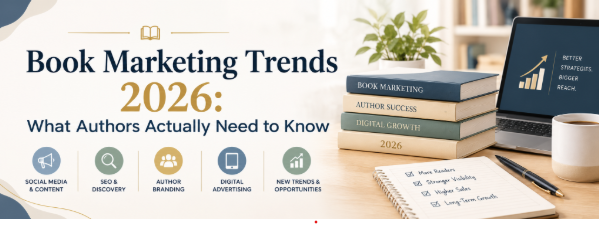
Book marketing trends 2026 center on five shifts. AI tools like ChatGPT are becoming a real discovery channel alongside Amazon search. BookTok and short-form video remain the fastest way to reach fiction readers. More authors are selling directly through Shopify and Kickstarter instead of relying only on retailers. Niche communities and micro-influencers are outperforming broad social reach. And authentic, unpolished author branding is beating overly produced content as AI content floods every platform.
Every year someone declares that book marketing has changed completely, and most years that is an exaggeration. This year is different. Between AI search, shrinking media coverage, and social platforms that reward rawness over polish, the playbook that worked in 2023 is genuinely losing effectiveness in 2026. This guide walks through what is actually shifting, based on reporting from people currently doing this work, not recycled advice.
AI and Discoverability: The Biggest Shift This Year
The single largest change in book marketing trends 2026 is how readers use AI to find books. This is not a future concern anymore. It is already happening, and the shift is fast enough that most authors have not caught up yet.
Bestselling author Joanna Penn, who writes extensively about the indie publishing industry, has been testing this directly. She reports finding books like Slashed Beauties and The Macabre through nuanced conversations with ChatGPT that she says she would never have discovered through a normal search. According to Penn, generative engine optimization is set to replace traditional search engine optimization as the way content gets discovered, since readers increasingly turn to AI chatbots and answer engines rather than typing keywords into Google.
That distinction matters for book discoverability AI specifically. A reader can now ask something like “a thriller set in a small town with a female journalist investigating a cold case” and get a genuinely specific recommendation, something a retailer search bar could never handle well. This means your book’s presence across the web, your website, interviews, reviews, author bio, needs to be detailed and conversational rather than just a stack of promotional keywords.
If you are wondering how to get your book recommended by ChatGPT, the honest starting point is checking whether you show up at all. Penn recommends searching your own author name on ChatGPT and on Google’s AI Mode to see what surfaces. In her own case, her Shopify store, website, podcast, and social accounts appeared, but Amazon listings did not. If your entire author presence lives only on Amazon, you may be functionally invisible to AI search right now.
Consistency across the web, being mentioned in reviews, interviews, and listicles, makes AI models more likely to surface your book as a genuine recommendation.
AI Tools for Book Marketing, Used the Right Way
Separate from discoverability, AI tools for book marketing are also changing how the actual work gets done. Publicist Kathleen Schmidt, who has spent over two decades in traditional publishing, put it plainly, noting that AI can help lighten the burden of publicity and marketing, since many new tools can now write pitches, build media lists, and send outreach on an author’s behalf.
The practical lesson is to treat AI as a drafting tool for ad copy, email sequences, and content outlines, then edit everything toward your actual voice before it goes out. Skipping that edit is the fastest way to sound like everyone else at exactly the moment readers are craving the opposite.
BookTok and Short-Form Video Marketing
Short-form video book marketing has not slowed down, even with AI content flooding every platform. BookTok specifically remains one of the most influential channels for romance, fantasy, thriller, and young adult fiction, and Reedsy’s research confirms Instagram performs similarly well for authors with a strong visual brand in the same genres.
If you are figuring out how to market a book on TikTok, the format that tends to work best is short, fifteen to thirty second video capturing a book’s mood and emotional premise rather than its plot summary. Genre fiction with a strong visual identity, horror, fantasy, romance, tends to perform best this way, since the format rewards atmosphere over explanation.
What has changed heading into 2026 is what counts as good book marketing video ideas. Author Alma Katsu, currently promoting her ninth novel, reported directly that engagement has tanked broadly across social platforms, not just for individual authors but for the micro and macro influencers publishers typically rely on too. Her conclusion, based on tracking social trends professionally for years, is that nobody has fully cracked what replaces the old formula yet, though live, in-the-moment content is emerging as one answer, since it carries an authenticity that pre-recorded video increasingly lacks.
Selling Books Direct to Readers
Direct sales for authors 2026 is one of the clearest structural shifts happening right now. Selling books direct to readers, through Shopify, Kickstarter, or in-person events, is no longer a niche tactic reserved for a handful of experimental authors.
According to a Written Word Media survey cited by Joanna Penn, thirty percent of authors surveyed were already selling direct as of late 2025, with another thirty percent planning to start in 2026. Among authors earning over ten thousand dollars a month, roughly half already sell direct. That is a meaningful shift in a relatively short window.
An author direct sales strategy is not a simple swap for uploading to Amazon, though. Penn is candid that selling direct is genuinely harder work, requiring upfront setup costs, ongoing tax and cash flow management, and a lot more proactive marketing than simply publishing an ebook and waiting. The upside is real too. You own your customer data outright, and email list size correlates directly with revenue. Data cited from Kindlepreneur shows authors with email lists over fifteen thousand subscribers earn twenty times more from direct sales than authors with lists under one hundred subscribers. Selling direct is not for a debut author with one book, but for anyone building a backlist, it is becoming a serious consideration rather than an experiment.
Niche Communities and Micro-Influencers
Niche book communities marketing is quietly outperforming broad reach strategies, and the data backs this up clearly. Reedsy points to a 2024 business research study showing that micro-influencers, generally those with five thousand to fifty thousand followers, tend to be more effective at social media marketing than significantly larger accounts.
This matters for how you think about book influencer marketing going forward. Rather than chasing the biggest possible audience, the more effective approach is finding smaller, highly engaged communities where your specific genre already lives, Discord servers, subreddits like fantasy or romance books, and genre specific Facebook groups. Micro-influencers for authors tend to have tighter, more trusting relationships with their followers than a much larger account with more diffuse reach, and that trust converts to actual sales more reliably.
Multi-Channel Strategy and Book Launch Planning
Multi-channel book marketing has become less optional as any single channel has gotten less reliable on its own. Relying entirely on Amazon algorithms, or entirely on one social platform, leaves an author exposed if that channel changes its rules, and platforms change their rules constantly.
The practical shape of book marketing channels 2026 tends to combine an owned email list, a presence on one or two social platforms chosen deliberately rather than everywhere at once, some form of earned media or community presence, and increasingly a direct sales channel alongside traditional retailers. A sound book launch strategy 2026 stacks these deliberately in the months leading up to release rather than scrambling to build all of them the week a book goes live.
Author Branding and Authenticity
Author branding trends this year are moving in a direction that might surprise anyone who assumes more polish always wins. Instagram’s own CEO, Adam Mosseri, wrote publicly that as AI generated content and deepfakes become harder to distinguish from real material, authenticity is becoming a genuinely scarce resource, and the creators who succeed will be the ones who can prove their content could only have come from them specifically.
That shift has direct implications for authentic author marketing. Mosseri’s own observation is that flattering, overly produced imagery is now cheap to produce and increasingly boring to consume, while unpolished, slightly imperfect content reads as more trustworthy precisely because it is harder to fake. For building an author brand 2026, this suggests leaning into real behind-the-scenes content, actual photos and unscripted video, rather than chasing a flawless aesthetic that increasingly looks identical to AI generated content anyway.
What This Means Going Forward
Pulling these book marketing predictions together, the future of book marketing looks less like a single new tactic replacing an old one, and more like several forces compounding at once. AI is reshaping discovery. Media coverage is shrinking even as more books get published. Social engagement is down across the board. And readers are gravitating toward smaller, more authentic spaces rather than broad, produced content.
None of this means marketing has become impossible. It means the authors who adapt earliest, who show up in AI search, build a direct relationship with readers instead of renting attention from an algorithm, and stay genuinely visible in the niche communities where their actual readers already are, will have a real advantage over those still running the 2023
playbook. Publishing industry trends 2026 broadly point toward the same conclusion from the traditional side too, with major publishers investing in AI workflows and direct reader relationships of their own, so this shift is not just an indie phenomenon.
At Bookstone Publishers, we build marketing plans around exactly these shifts rather than defaulting to whatever worked a few years ago, since a strategy that ignores where readers are actually spending their attention in 2026 is a strategy built to underperform. If you are planning a launch this year, it’s worth having that conversation before your marketing plan is already locked in.
Frequently Asked Questions
What are the biggest book marketing trends for 2026?
The biggest shifts are AI powered book discovery, continued strength of short-form video like BookTok, growth in direct-to-reader sales, the rising effectiveness of niche communities over broad reach, and a move toward authentic, less produced author branding.
How are readers using AI to find books?
Readers are increasingly asking AI tools like ChatGPT detailed, conversational questions about what they want to read next, receiving specific recommendations that traditional keyword search cannot match.
Is BookTok still worth investing time in for 2026?
Yes, especially for romance, fantasy, thriller, and young adult fiction, though engagement broadly has declined, so content needs to feel more authentic and less produced than in previous years.
Should authors sell books directly instead of through Amazon?
Selling direct works best for authors with an existing catalog and audience, since it requires more upfront effort, but it offers direct customer data and has grown significantly among established authors heading into 2026.
What is generative engine optimization for authors?
It refers to optimizing an author’s online presence, website, bio, and content, so AI search tools reference and recommend their books, rather than focusing solely on traditional search engine rankings.
Do micro-influencers work better than larger influencers for book marketing?
Research suggests micro-influencers with five thousand to fifty thousand followers often outperform much larger accounts for book marketing, due to stronger audience trust and engagement.
How has author branding changed for 2026?
Authenticity has become more valuable as AI generated content increases, with unpolished, genuine content increasingly outperforming heavily produced material across social platforms.