
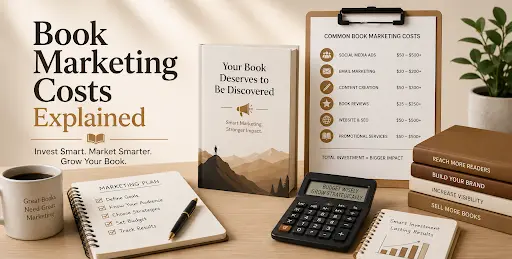
Book marketing typically costs $500 to $2,500 for a freelance marketer, $3,500 to $15,000+ for a full agency campaign, and $1,500 to $10,000 for a publicist. On top of services, paid ad spend usually runs $300 to $1,500 a month. Most first-time authors land somewhere between $500 and $5,000 for a full launch.
That range is wide on purpose, because your actual number depends on three things: your publishing path, your book’s format, and what you’re actually trying to achieve.
When you ask ten authors, what book marketing costs, and you’ll get ten different answers. That’s not because anyone is lying to you. It’s because “book marketing” can mean a $25 newsletter listing or a $30,000 publicist retainer, and almost nobody explains where you actually fall on that scale.
What Actually Drives Book Marketing Campaign Cost
Genre is the first variable. Romance and thriller readers respond strongly to paid ads and BookBub-style promotions, since these genres carry large, well-defined retailer audiences. Literary fiction and poetry generally don’t see the same return, regardless of spend, because the reader base for paid discovery ads is simply smaller.
Your publishing path is the second variable. Whether you’re traditionally published, self-published, or working with a hybrid publisher changes not just who pays, but how much control you have over where that money goes.
Format is the third variable. An ebook campaign, a print campaign, and an audiobook campaign pull on completely different levers, different platforms, different promo channels, different cost structures and lumping them together into one generic “marketing budget” is exactly why so many authors overspend on the wrong channel for their actual book.
A fourth factor worth naming directly: how many books you have. A single standalone title and a five-book series justify wildly different marketing budgets, even if the per-book quality is identical, simply because a series lets one reader’s acquisition cost get repaid multiple times over.
Quick Reference: Cost by Path and Format
| Publishing Path | Ebook | Audiobook | |
|---|---|---|---|
| Traditional | Limited publisher ad spend; author often supplements | Publisher-funded distribution; author covers events | Rarely publisher-prioritized; author-funded if pursued |
| Self-Published | $200–$1,500 (ads, promo sites) | $100–$800 (events, author copies) | $500–$2,000 (podcast ads, audio promo sites) |
| Hybrid | $300–$1,500 (shared with package) | $200–$1,000 (shared with package) | $500–$1,800 (often add-on) |
Your actual number depends on reading down and across, not picking one column in isolation.
If you want help figuring out your actual number instead of guessing from a range, that’s exactly the kind of budget conversation Bookstone Publishers has with authors regularly because the right spend for your book depends on your book, not an industry average.
Cost by Publishing Path
For Traditional
Traditionally published authors typically receive some publisher marketing support, but it’s thin. According to Bowker data reported by Publishers Weekly, roughly 4.2 million new titles were published in the U.S. in 2025 alone, with that much competing for a limited marketing budget, most publishers concentrate spend on lead titles only, leaving debut and mid-list authors to fund a meaningful share themselves.
For Self-publishing
Self-published authors carry the full cost, typically $500 to $5,000 for a first launch. There’s no publisher subsidy, but there’s also no gatekeeper limiting what you try.
For Hybrid
Hybrid-published authors usually land in between $1,000 to $4,000 out of pocket is common, since a publisher-style team handles some logistics while the author still funds and directs the campaign. At Bookstone Publishers, this is exactly where our own marketing packages are priced, since a hybrid author shouldn’t pay full agency rates for support that’s already partly built into their publishing package.
Marketing Cost By Format
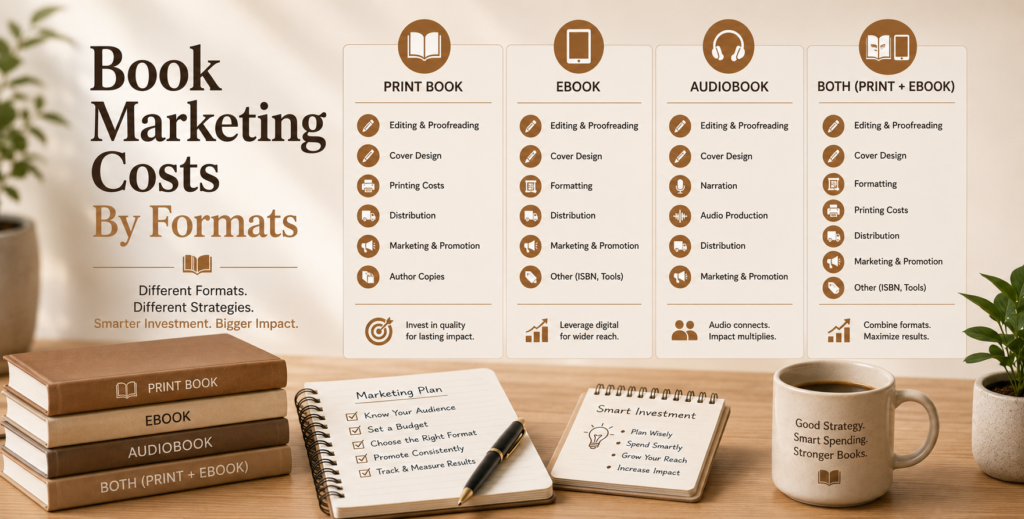
Ebook marketing is the cheapest to start. A basic Amazon Ads test runs $5 to $15 a day, and average cost-per-click sits in a comparable range to general Amazon advertising, where typical ACOS (advertising cost of sale) runs 25% to 36%, according to Ad Badger’s 2026 Amazon Advertising benchmark report.
Print marketing costs show up differently in event costs, author copies, and local press outreach rather than ad platforms. A single local launch event typically runs $100 to $500 once you count venue, refreshments, and printed copies for signing.
How much does audio book marketing cost specifically? Podcast guest placements are often free beyond your time, but paid podcast advertising runs $500 to $2,000 for a focused campaign, and audiobook-specific promo sites charge similarly to their ebook counterparts. This gap matters; audiobook revenue actually overtook ebook revenue industry-wide in 2024, growing 22.5% to $2.4 billion compared to ebooks’ 1.5% growth to $2.1 billion, according to the Association of American Publishers’ StatShot Annual report.
What is Included in Price and What isn’t
This confuses more authors than almost anything else in this topic. A quoted price and your total cost are often two different numbers.
Ad management and ad spend are usually billed separately. A marketer might charge $400 a month to manage your Amazon Ads campaign but the actual money paid to Amazon for clicks is a separate budget on top of that fee, not included in it.
Publicist retainers typically cover outreach efforts, not guaranteed placements. You’re paying for pitching, follow-up, and relationship access, not a specific number of articles or interviews, since no legitimate publicist can guarantee earned media outcomes.
Always ask directly: does this price include ad spend, or just the service managing it? Getting this answer before signing anything avoids the most common billing surprise in this entire industry.
Book Marketing Services Cost, Tier by Tier
So how much does a book marketer cost once you’re paying someone else to run this? It breaks into four rough tiers.
A freelance marketer, hired per project, typically charges $500 to $2,500 depending on scope. This usually covers a single campaign phase, like a launch push or an ARC coordination effort, not ongoing management.
A book marketing company or agency charges considerably more: $3,500 to $15,000 or beyond, for a coordinated multi-channel campaign involving strategy, outreach, and reporting across several platforms at once.
A publicist specifically, someone focused on earned media rather than paid promotion typically runs $1,500 to $10,000, often billed monthly across a 3 to 6 month campaign.
Group coaching programs, where you learn to run your own campaign with guidance, sit lower: roughly $1,000 to $2,500 for a multi-month program, ad spend separately. This route works best for authors who have some time to invest in learning platforms directly, rather than handing the entire process to someone else.
Author branding packages covering messaging, bio, and media kit development rather than ongoing campaign management typically run $1,000 to $5,000 as a flat, one-time fee. These sit slightly outside the four core tiers above but come up often enough in author budgets to be worth naming separately.
One thing worth quoting directly: BookBub’s own partners pricing page notes that Featured Deal costs vary “based on the book’s category, discount price, and regional availability” meaning there’s no single number, only a real range you check before applying, not one fixed rate everyone pays.
The Cost of Book Marketing Services for New Authors Specifically
First-time authors face a specific trap: spending agency-level money on a book that isn’t ready for it yet.
If this is your only book, a modest budget is usually the right call $50 to $300 in newsletter promo sites and a small Amazon Ads test, rather than a large agency retainer.
The reason is straightforward. A single standalone title rarely generates enough lifetime revenue to justify a $5,000+ campaign. That math changes considerably once you have two or three books in a series, which is exactly why many experienced marketers recommend waiting until a backlist exists before scaling spend.
The Metric That Matters More Than Any Price Tag
The actual number that matters isn’t what you spend, it’s what it costs you to acquire one new reader, compared to what that reader is worth to you.
The formula is simple: divide your total ad spend by the number of new readers it brought in. That’s your cost per reader. Compare that number to what an average reader is worth across your backlist, one book’s royalty, or several if they read your whole series and you know whether a campaign is actually profitable, not just active.
A single $4 reader is a loss on a $3.50 royalty from one standalone book. That same $4 reader is a solid win if they go on to buy four more books in your series. The spend didn’t change. The math did and that’s true whether you’re running ebook ads, funding a podcast placement for your audiobook, or paying for a print event that brings in email signups instead of direct sales.
Here’s a worked version. Say you spend $300 on ads and acquire 75 new readers, that’s $4 per reader. If your book is a standalone earning $3.50 in royalty per sale, you’ve technically lost money on that batch of readers even before accounting for the readers who never buy again. But if that same $4 reader goes on to buy the next three books in your series, each earning a similar royalty, that one reader is now worth roughly $14 to you, a genuinely profitable trade from identical spend. The number that matters isn’t the $300. It’s what happens after the first sale.
When You Should Not Spend Money Yet
If your cover, blurb, or categories don’t match what’s actually selling in your genre, more ad spend won’t fix that it just makes the mismatch more expensive to discover.
If you have fewer than 10 to 15 reviews, hold off on paid promotion. Both algorithms and human readers treat review count as a trust signal, and traffic sent to an unreviewed book converts poorly regardless of channel.
If this is your only book and your budget is under $500, the better investment is often finishing book two, not stretching a single title’s marketing further than the math supports.
If you’re not sure what “ready” actually looks like, a simple gut check helps: would a stranger browsing your genre stop scrolling at your cover, understand what the book offers within your description’s first two lines, and trust it enough to click through with the reviews currently on the page? If the honest answer is no to any of those, that’s the $0 fix to make before any paid fix.
A Real Life Example of Getting Order Right
We recently worked with a first-time nonfiction author who wanted to spend her entire $3,000 budget on Facebook ads before launch. Instead, we split it: $500 on foundation work (a professional book description rewrite and category research), $1,000 on an ARC campaign to build reviews, and the remaining $1,500 on a staged ad test after 19 honest reviews were live. The campaign converted meaningfully better once ads had actual social proof to point to; a reminder that sequencing matters as much as the total number on the invoice.
The lesson generalizes well beyond this one project. Authors often assume the fix for a slow launch is more ad spend, when the actual fix is usually earlier in the sequence. Stronger positioning, more reviews, a clearer sense of who the book is for. Spending the same total budget in a different order frequently produces a meaningfully different result.
Frequently Asked Questions Related to Book Marketing Cost
How much does it cost to market a book?
Most authors spend $500 to $5,000 for a self-published launch, $1,000 to $4,000 for hybrid-supported marketing, and considerably less out of pocket for traditional publishing, though publisher support is often limited to lead titles.
What is the average cost of book marketing for a first-time author?
A realistic first launch runs $500 to $2,000 for most self-published authors, covering ARC distribution, a small ad test, and a few promo site listings. Larger agency campaigns rarely make financial sense before a backlist exists.
How much does a book marketing company cost?
Full-service agencies typically charge $3,500 to $15,000 or more per campaign, depending on scope, channels involved, and campaign length. Always confirm whether ad spend is included in the quote or billed separately.
How much does audio book marketing cost specifically?
Audiobook-specific promotion podcast ads, audio-focused promo sites typically run $500 to $2,000 for a focused campaign, similar to ebook promo costs, though the format is far less covered in most marketing budgets despite growing faster than ebooks industry-wide.
Is it worth hiring a book marketer instead of doing it yourself?
It depends on your time, budget, and how many books you have. Hiring help tends to pay off once you have a backlist and a clear goal; it’s a harder case to make for a single standalone title with a tight budget.
Does ad spend count as part of a book marketing services cost quote?
Not always. Many marketers and agencies bill a management fee separately from actual ad spend on platforms like Amazon or Meta. Always confirm whether a quoted price includes advertising costs or only covers the service managing them.
What’s the average cost of book marketing across all paths combined?
Averaging across self-published, hybrid, and lightly-supplemented traditional launches, most authors spend somewhere between $500 and $4,000 on their first book’s marketing, with the wide variation almost entirely explained by format choice and how many books already exist in a series.