
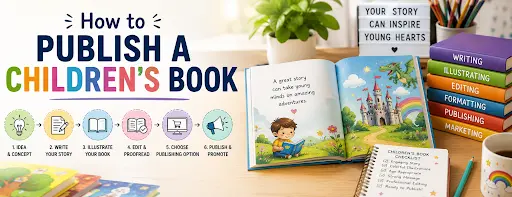
Publishing a children’s book comes down to five stages: writing a manuscript suited to your target age group, finding the right illustrator, deciding between traditional publishing or self-publishing, handling ISBN and copyright registration correctly, and getting your finished book into the hands of readers. Most first-time authors spend more time on this last step than any other, which is exactly why so many end up working with a children’s book publishing company rather than going it entirely alone.
Here’s the full walkthrough, with real numbers, and real costs.
Why Publishing a Children’s Book Takes a Different Approach
Writing for kids looks simple from the outside. Fewer words, bigger pictures, how hard can it be? Ask anyone who’s actually tried it, and you’ll get a different answer. Every sentence has to earn its place, the story has to work read aloud, and somewhere in there you also need illustrations that carry half the storytelling weight. It’s a different craft than adult fiction, and the publishing path looks a little different too.
It’s also a crowded field, and getting more so. Bowker’s most recent industry data, reported by Publishers Weekly, shows that self-published output in the U.S. jumped nearly 39% in a single year, with total published titles topping four million for the first time. That’s not a reason to feel discouraged. It’s a reason to make sure your book, whether you’re publishing it yourself or sending it to children’s book publishers, is genuinely ready before it goes out into the world.
Publishing a children’s book isn’t one decision, it’s a series of smaller ones; age group, format, illustration style, publishing route, and eventually, how the book actually reaches readers. Getting each of those right in order tends to matter more than rushing toward a finished product.
Know Your Age Group Before You Write Another Word
Every decision that follows word count, page count, vocabulary, illustration style flows from one question: who is this book actually for? Publishers and printers alike sort children’s books into fairly consistent age brackets, and working within them makes your manuscript easier to place, whether you’re querying an agent or formatting it yourself.
| Age Group | Typical Format | Word Count | Page Count |
| 0–3 | Board book | 0–100 words | 12–24 pages |
| 4–6 | Picture book | 500–1,000 words | 24–32 pages |
| 7–9 | Early reader / chapter book | 2,500–10,000 words | 32–64 pages |
| 10–12 | Middle grade | 20,000–50,000 words | 100–250 pages |
These numbers are industry norms, not laws. But if your picture book manuscript comes in at 3,000 words, that’s a signal worth paying attention to before you go further. Publishers and printers use these brackets to decide trim size, paper weight, and even font size, so nailing this early saves you from reformatting everything later.
Step 2: Write, Then Rewrite
This is how to write and publish a children’s book that actually works.
The first draft is rarely the one that gets published. Read your manuscript out loud, more than once. Picture books in particular live or die on rhythm. Kids notice when a sentence doesn’t sound right in a way adults often talk themselves out of noticing. Cut anything that isn’t pulling weight. At 500 words, every single one matters.
A few things worth checking before you consider the manuscript finished:
- Does the story have one clear character who wants something and runs into a problem getting it?
- Would a five-year-old actually stay interested if you read this aloud right now?
- Have you cut every word an editor would flag as unnecessary?
- Has someone outside your immediate family read it and given honest feedback?
That last point matters more than it sounds like it should. Joining a critique group or a professional organization solves this. The Society of Children’s Book Writers and Illustrators, the largest organization of its kind, has grown to more than 22,000 members worldwide which gives you access to critique partners, market news, and illustrators who already understand this specific corner of publishing.
Step 3: Find an Illustrator Who Fits Your Story
This step gets skipped over in almost every other guide on publishing a children’s book, which is strange, because for picture books, the illustrations often matter as much as the text. A few realistic paths:
Hire a freelance illustrator: Expect to pay anywhere from $1,500 to $8,000+ for a full picture book, depending on experience and page count. Always work from a written contract that spells out usage rights.
Work-for-hire vs. royalty split: Work-for-hire means you pay once and own the art outright. A royalty split means lower upfront cost but shared ongoing income, decide which fits your budget and your plans for the book before you start reaching out.
Illustrate it yourself: Entirely possible if you have the skill, and it keeps full creative control in one set of hands.
Use an illustrator-matching platform or directory: Sites built specifically for children’s book illustration make it easier to compare portfolios and styles before committing.
Whichever route you choose, get the agreement in writing before any art is delivered. This single step prevents most of the disputes that come up later around who owns what.
Traditional Publishing: Working With Children’s Book Publishers
If you want a traditional publisher to take on the printing, distribution, and marketing, you’re looking at querying literary agents or submitting directly to children’s book publishing companies that accept unagented manuscripts. This path is genuinely competitive; most publishers see thousands of submissions a year and the timeline from acceptance to a book on shelves commonly runs one to two years, sometimes longer.
- Research agents and publishers who specifically represent your genre and age group.
- Write a tight, professional query letter most want the full manuscript for picture books, sample chapters for longer formats.
- Expect rejection to be part of the process, not a sign your book isn’t good enough.
Children’s Book Self-Publishing: How to Self-Publish a Children’s Book Yourself
Self-publishing puts you in the driver’s seat on timeline, pricing, and creative control and it’s the route the Bowker data above shows more authors choosing every year. The core steps for children’s book self-publishing look like this:
Format your interior file: Larger fonts (16–24pt) work better for younger readers than the standard 11–12pt used in adult books.
Choose print and distribution platforms: Amazon KDP, IngramSpark, and print-on-demand services each have different reach, cost structures, and retail availability compare more than one before committing.
Design a cover that reads well as a thumbnail: Most readers will discover your book on a screen before they ever hold it.
Order a proof copy before your full print run: Colors and trim sizes can look different on screen than they do on paper.
One more thing worth deciding early: hybrid publishing sits between these two paths. A hybrid publisher handles production and distribution like a traditional house, but the author pays some or all of the upfront costs and keeps a larger royalty share in return. It’s not the right fit for every book, but it’s worth knowing the option exists before you assume your only choices are fully traditional or fully self-published.
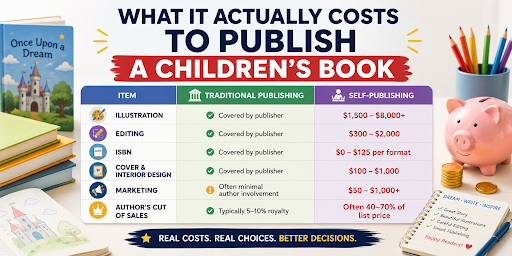
What It Actually Costs to Publish a Children’s Book
Costs vary widely by path. Here’s a realistic, platform-neutral range for each stage:
| Item | Traditional Publishing | Self-Publishing |
| Illustration | Covered by publisher | $1,500–$8,000+ |
| Editing | Covered by publisher | $300–$2,000 |
| ISBN | Covered by publisher | $0–$125 per format |
| Cover & interior design | Covered by publisher | $100–$1,000 |
| Marketing | Often minimal author involvement | $50–$1,000+ |
| Author’s cut of sales | Typically 5–10% royalty | Often 40–70% of list price |
ISBN and Copyright: The Part Almost Nobody Explains Properly
Children’s books create a copyright wrinkle that most general publishing guides never mention: text and illustrations are two separate copyrightable works when they’re created by different people. According to the U.S. Copyright Office’s own guidance on multiple works, a children’s book created by a writer and illustrator working together can be registered either jointly or as separate claims, depending on how ownership is structured between the two of you.
In practice, that means your contract with your illustrator should spell out exactly who owns what, and how registration will be handled, before any art is finalized. On the ISBN side, each format of your book hardcover, paperback, eBook technically needs its own ISBN, which is worth budgeting for if you’re planning to release your children’s book in more than one format.
Choosing the Right Children’s Book Publisher
A lot of authors start their search by typing “children’s book publishers near me” into Google, assuming a local relationship matters. In practice, it rarely does anymore. Most reputable children’s book publishing companies work with authors entirely remotely: manuscript review, editing, design, and printing can all happen without anyone being in the same city, let alone the same building.
What actually matters is whether a publisher takes the time to understand your specific book instead of running it through a generic pipeline. At Bookstone Publishers, that’s the starting point for every project. A real conversation about your manuscript, your age group, and your goals before anyone recommends a path forward. Authors working with Bookstone Publishers get that same level of attention whether they’re down the street or on the other side of the country.
Publishing a children’s book takes more coordination than most first-time authors expect; the right age-group fit, a manuscript that survives being read aloud, an illustrator you trust, and a publishing path that matches your goals and budget. None of it has to happen alone. Whether you’re weighing traditional children’s book publishers, exploring self-publishing for the first time, or just trying to figure out which path fits your book, Bookstone Publishers works alongside authors through every one of these decisions, from the first manuscript read to the finished copy in a reader’s hands.
Mistakes First-Time Children’s Book Authors Make
Writing too long for the age group: A 2,000-word picture book is a common early draft and almost always needs cutting by more than half.
Skipping a contract with the illustrator: Verbal agreements cause real problems once a book starts earning money.
Paying a publisher upfront: A legitimate traditional publisher never asks the author to pay for their own book’s production.
Ignoring the read-aloud test: A story that reads fine silently can fall apart the moment it’s spoken out loud to a child.
Underestimating illustration timelines: A full picture book’s worth of art can take several months, plan backward from your desired publication date.
Frequently Asked Questions
How many words should a children’s book be?
It depends on the age group. Picture books for ages 4–6 typically run 500–1,000 words, while middle grade novels for ages 10–12 can run 20,000–50,000 words or more.
Do I need an agent to publish a children’s book?
Not always. Some children’s book publishers accept unagented submissions, though an agent can open doors to larger publishing houses and help negotiate contracts.
How much does it cost to self-publish a children’s book?
Costs typically range from a few hundred dollars for a very simple project to $5,000 or more once illustration, editing, and marketing are all included.
Can I illustrate my own children’s book?
Yes, if you have the skill for it. Many successful self-published children’s authors are also their own illustrators, which keeps full creative control in one place.
Do children’s book publishers near me matter for getting published?
Not as much as most authors expect. Nearly all publishing work today happens remotely, so a publisher’s location matters far less than their experience with your genre and age group.
What’s the difference between traditional and self-publishing for children’s books?
Traditional publishing means a company invests in your book and pays you a royalty, but the process is competitive and slow. Self-publishing means you invest the money yourself, but you keep more of the profit and full control over the timeline.