
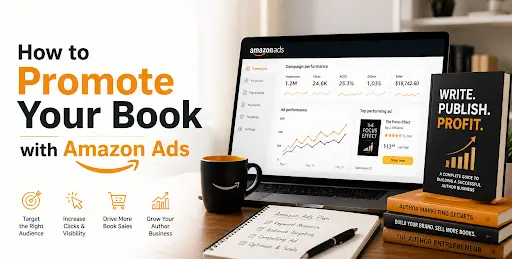
Promoting a book successfully means sequencing three things in order: build your author brand and get your product page ready first, gather at least ten to fifteen reviews before spending on ads, then run targeted Amazon Sponsored Products ads alongside a concentrated launch-week push. Skipping the order, especially running ads before the page is ready is the most common reason book marketing underperforms.
Most authors don’t struggle to write a book. They struggle to sell one. You can spend two years on a manuscript, hire a great editor, and commission a beautiful cover, and still watch your book sit on page nine of Amazon search results with zero reviews and three sales, one of which was your mom. That’s not a writing problem. It’s a marketing problem, and it’s the single biggest gap between authors who build a career and authors who publish once and quietly stop.
The good news is that book marketing isn’t a mystery. It’s a sequence. Branding tells readers who you are and why they should care. Amazon Ads put your book in front of people already looking for something like it. Launch strategy times everything so it lands with momentum instead of trickling out to nobody. Skip any one of the three and the others work harder for less return.
Why Book Marketing Has to Start Before Launch Day
A common mistake is treating marketing as something that starts after the book goes live. A press release here, a few social posts there, maybe an Amazon ad once sales feel slow. By then, you’ve already missed the window when marketing is cheapest and most effective.
Every reader who lands on your book page is making a snap judgment based on three things: the cover, the description, and the reviews. If those aren’t dialed in before you spend a single dollar on advertising, you’re paying to send traffic to a page that isn’t ready to convert it. That’s the quiet reason so many authors feel like Amazon Ads “don’t work”. The ad did its job and brought a reader to the page. The page just didn’t close the sale.
Marketing that starts early isn’t about being loud months in advance. It’s about making sure the foundation of your brand, your product page, and your positioning is solid before you start paying attention toward it.
Building an Author Brand Readers Actually Remember
Branding sounds like a word for corporations, but for an author it’s simpler than it sounds: it’s the answer to “why should I read something else by this person?” Readers don’t just buy books. Increasingly, they follow authors. A strong brand is what turns a one-time buyer into someone who pre-orders your next release.
Your Author Bio Is Doing More Work Than You Think
A vague, modest bio (“John lives in Chicago with his family and two cats”) wastes prime real estate. A good bio tells a reader what kind of books to expect from you next and gives them a reason to trust your authority on the subject, especially for nonfiction.
Visual Consistency Builds Recognition
Your cover style, website, and social presence should feel like they belong to the same person. This matters more in genre fiction, where readers scan covers quickly and make snap genre assumptions. A cover that doesn’t match reader expectations for its category can suppress sales no matter how good the writing is.
Know Who You’re Actually Writing For
“Everyone” is not an audience. The more specifically you can describe to your ideal reader what else they read, what they care about, where they spend time online, the easier every other marketing decision becomes, from ad targeting to cover design to where you spend your limited promotional time.
Amazon Ads for Authors: What They Are and How They Work
Amazon is where the majority of book purchases happen, which makes it the highest-leverage place to advertise for most authors. Amazon offers authors a couple of core ad formats worth understanding before you spend anything.
Sponsored Products are the most common starting point. These ads put your book in front of shoppers actively searching for similar titles or genres, showing up in search results and on other books’ product pages across Amazon, Kindle, and Goodreads.
Sponsored Brands are built for authors with a small catalog. Amazon requires three or more eligible titles under one author name to run this format and let you showcase a collection of books or tell your author story in a branded ad unit rather than promoting a single title.
Before you can advertise at all, your book needs to be claimed in Amazon Author Central and meet Amazon’s creative and eligibility guidelines. Skipping this step is one of the more common early stumbling blocks for first-time advertisers.
Getting Your Book “Ad-Ready” Before You Spend a Dollar
This step determines whether your ad spend turns into sales or just burns cash. Experienced Amazon Ads managers who’ve audited large numbers of author accounts point to the same handful of recurring problems: keywords with too little search volume to matter, a product page that isn’t doing its job, and not enough reviews yet to earn reader trust.
On reviews specifically, Amazon itself recommends authors have at least ten reviews in place before running ads, and most experienced ad managers suggest aiming meaningfully higher than that for steady results. Reviews function as social proof, they tell a stranger considering your book that other real readers finished it and thought it was worth their time.
Your product page matters just as much as the ad itself. A cover that doesn’t read clearly at thumbnail size, a description that doesn’t hook a reader in the first two lines, or a missing sample chapter will all quietly cap how well any ad campaign can perform, no matter how well-targeted the keywords are.
Common Amazon Ads Mistakes First-Time Authors Make
- Targeting broad, high-competition keywords instead of specific, closely related ones a real reader would search.
- Launching ads before the book has enough reviews to convert the traffic the ad sends.
- Setting a budget and walking away instead of checking performance weekly in the early weeks.
- Advertising a book whose cover or description doesn’t clearly signal its genre.
- Giving up after a few days instead of letting a campaign collect enough data to optimize.
None of these mistakes are really about Amazon’s ad platform being confusing. They’re about skipping the branding and page-readiness work that has to happen first.
Launch Strategy: Turning Attention Into Sales
A launch isn’t a single day. It’s a short window where Amazon’s algorithm is paying closer attention to your book than it ever will again, and how you use that window affects your visibility for months afterward.
Before Launch: Build a Small Base
Advance reader copies sent to a small group of engaged readers ahead of release let you go live with a handful of reviews already in place, instead of launching to a blank product page. Even five or six honest reviews on day one changes how the page reads to a new visitor.
Launch Week: Concentrate, Don’t Spread Thin
Rather than posting sporadically for a month, concentrated activity in the first week, social posts, an email to your list, any press or podcast outreach you’ve lined up, tends to create more momentum than the same effort spread over a longer stretch.
After Launch: Keep a Small, Steady Push Going
Once the initial wave passes, a light, consistent presence, an occasional ad adjustment, continued requests for honest reviews, cross-promotion once you publish a second title keeps a book from going quiet. Many authors treat launch week as the finish line, when it’s really close to the starting gate for a book’s long-term sales life.
Bringing Branding, Ads, and Launch Together
These three pieces aren’t separate projects, they’re stages of one plan, and the order matters:
| Timing | What to Focus On |
| 4–6 weeks before launch | Finalize cover, description, and author bio; recruit advance readers |
| 1–2 weeks before launch | Collect advance reviews; prep social posts and email announcement |
| Launch week | Concentrate outreach; hold off on paid ads until reviews are in place |
| 2–4 weeks after launch | Start Amazon Ads with a small, targeted keyword list; check weekly |
| Ongoing | Refine ad targeting, keep requesting reviews, plan for book two |
Treated this way, marketing stops feeling like a scramble after the fact and starts working the way it’s supposed to. Each piece makes the next one more effective instead of fighting for attention on its own.
None of this requires a huge budget or a marketing background. It requires sequencing: brand first, page-readiness second, paid ads third, and a launch plan that ties all of it together instead of throwing everything at the wall on release day.
At Bookstone Publishers, this is the same sequence we walk authors through on every project. Pairing editing and design with a clear-eyed marketing plan so a finished manuscript actually finds its readers. If building out that plan on your own feels like a lot to manage alongside the writing and editing itself, our team can help carry it, from author branding and cover design through to launch-week execution and ad strategy.
Frequently Asked Questions
How do I market a self-published book on Amazon?
Start by making sure your book’s cover, description, and author bio clearly signal its genre, then gather at least ten to fifteen honest reviews before running any paid ads. Once the product page is ready, Amazon Sponsored Products ads let you target readers already searching for similar books.
What is the best way to use Amazon Ads for a new book?
The best approach is to start small: pick ten to fifteen closely related keywords instead of broad genre terms, set a modest daily budget, and review performance weekly for the first month before increasing spend on what’s actually converting.
How many reviews do I need before running Amazon Ads?
Amazon recommends at least ten reviews before advertising a book, though many authors see steadier results waiting until they have twenty or more. Reviews act as social proof that helps convert the traffic an ad sends.
What’s the difference between Sponsored Products and Sponsored Brands on Amazon?
Sponsored Products promote a single title in search results and on other books’ pages, and any author can run them. Sponsored Brands showcase a collection of titles or an author’s story, but require at least three eligible books under one author name.
When should I start marketing my book?
Book marketing should start weeks before launch, not after. Locking in your author brand, product page, and a small group of advanced readers before release day gives your book reviews and credibility from day one instead of a blank page.
Do I need a big budget to market a book effectively?
No. A clear author brand, a handful of early reviews, and a small, well-targeted Amazon Ads budget will outperform a large, unfocused spend. Sequencing branding first, then ads, then launch push, matters more than budget size.
How long should I run Amazon Ads for my book?
Amazon Ads work best as an ongoing, adjusted campaign rather than a short burst. Most authors keep campaigns running continuously, refining keywords and bids every few weeks based on which ones are actually converting into sales.