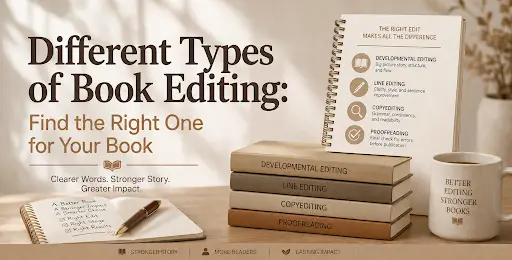
If you’ve just finished a manuscript, you’ve probably typed “types of book editing” into a search bar at least once, trying to figure out what your book actually needs before it goes anywhere near a publisher or a reader. It’s a fair question, and a confusing one. Editors use terms like developmental editing, line editing, copyediting, and proofreading almost interchangeably in casual conversation, but each one covers a different stage of a manuscript’s life, requires a different skill set, and solves a different problem.
At Bookstone Publishers, this is one of the questions we hear most often from first-time authors, and even from writers who’ve published before but never worked with a structured editorial team. This guide walks through every major type of editing for books, what each one actually involves, when to use it, and how to figure out where your manuscript stands right now. By the end, you’ll know exactly what to ask for the next time you hire an editor or submit your work for review.
Why the Type of Editing You Choose Actually Matters
Hiring the wrong kind of editor at the wrong stage is one of the most common (and expensive) mistakes new authors make. Paying for a line-by-line polish before the plot structure is sound means paying for the same pages twice, once now and once after a developmental pass reshapes half the book. Skipping structural work entirely and going straight to proofreading leaves plot holes, pacing problems, and weak character arcs untouched, no matter how clean the grammar looks.
Editing generally moves from big-picture to small-picture. Think of it as zooming in gradually: first the whole forest, then the trees, then the leaves, then the dust on the leaves. Each stage below follows that order.
1. Manuscript Evaluation (Editorial Assessment)
Before any actual editing begins, many authors start with a manuscript evaluation, sometimes called an editorial assessment or manuscript critique. This isn’t editing in the traditional sense. No sentences get rewritten and no chapters get restructured. Instead, an editor reads the full manuscript and delivers a detailed report covering strengths, weaknesses, pacing issues, character development, market fit, and overall readiness.
This step is especially useful for authors who aren’t sure whether their book is ready for developmental editing or still needs significant revision on their own first. A good assessment tells you where to focus your energy before you spend money on deeper editorial work.
Best for: Authors who want an honest, high-level diagnosis before committing to a full edit.
2. Developmental Editing
Developmental editing, sometimes called structural or content editing, is the most involved of the editing types. It looks at the manuscript as a whole system rather than at individual sentences. A developmental editor asks questions like: Does the plot hold together? Are the stakes clear? Does the protagonist actually change? Does the pacing drag in the middle third? Is the argument in a nonfiction book logically sequenced and well supported?
This stage often results in significant revision. Chapters might get reordered, cut, or rewritten entirely. Characters might need new motivations. A nonfiction outline might need to be restructured so the argument builds more convincingly. Because of the depth of work involved, developmental editing usually takes the longest and costs the most of any editing stage, but it’s also the stage that has the biggest effect on whether a book actually succeeds with readers.
Best for: First drafts, manuscripts with structural or pacing problems, and any book where the author suspects something isn’t working but can’t quite name it.
3. Line Editing
Once the structure is solid, line editing focuses on how the story or argument is told at the sentence and paragraph level. This is where a line editor works on voice, tone, rhythm, clarity, and flow. They’ll flag sentences that are awkward, passages that tell instead of show, dialogue that doesn’t sound natural, and transitions that feel abrupt.
Line editing is less about correctness and more about craft. A grammatically perfect sentence can still be flat, repetitive, or tonally off, and that’s exactly what a line editor is trained to catch. Many authors confuse line editing with copyediting, but the two focus on different things. Line editing shapes how the writing reads; copyediting makes sure it’s technically correct.
Best for: Manuscripts with a solid structure that need the prose itself sharpened and elevated
4. Copyediting
Copyediting is where the technical side of the manuscript gets addressed. A copyeditor checks grammar, spelling, punctuation, syntax, and consistency, things like whether a character’s eye color stays the same from chapter three to chapter twenty, whether numbers are formatted consistently, and whether the manuscript follows a consistent style guide (Chicago Manual of Style is the standard for most trade fiction and nonfiction).
Copyediting also includes fact-checking in nonfiction work and continuity checks in fiction. It’s a detail-oriented, methodical pass rather than a creative one. By this stage, the story and the voice should already be where the author wants them; copyediting exists to make sure nothing undermines that with careless errors or inconsistencies.
Best for: Manuscripts that are structurally and stylistically finished and need technical accuracy and consistency.
5. Proofreading
Proofreading is the final quality check before publication, and it’s often the type of editing people mean when they say “editing” in casual conversation, even though it’s actually the last and lightest stage. A proofreader reviews the fully formatted manuscript, the version that’s about to go to print or upload as an ebook, and catches typos, formatting errors, missing punctuation, and layout issues like awkward page breaks or inconsistent spacing.
Proofreading is not the time to revise sentences or rework paragraphs. If an editor is still suggesting major rewrites at the proofreading stage, something was skipped earlier in the process. This step exists purely to catch what slipped through everything before it.
Best for: The final formatted manuscript, immediately before publication.
6. Technical Editing
Technical editing applies to nonfiction books that involve specialized subject matter, textbooks, scientific writing, medical guides, software documentation, or instructional content. A technical editor checks the accuracy of specialized terminology, verifies that instructions or processes are correctly explained, and makes sure diagrams, charts, and data are presented clearly and correctly.
This type of editing usually requires subject-matter expertise in addition to editorial skill, since catching a factual or procedural error means actually understanding the field the book is written in.
Best for: Textbooks, how-to guides, technical manuals, and specialized nonfiction.
7. Sensitivity Reading
Sensitivity readers review a manuscript for authentic and respectful representation of specific experiences, cultures, or identities that may differ from the author’s own. This isn’t about censorship; it’s about accuracy and avoiding unintentional stereotypes or factual missteps when writing outside your own lived experience. A sensitivity reader might flag dialogue that feels inauthentic, cultural details that are inaccurate, or portrayals that could unintentionally reinforce harmful assumptions.
This step is increasingly common in both traditional and self-publishing, particularly for stories involving characters from underrepresented communities, disabilities, or historical trauma.
Best for: Manuscripts that include perspectives, cultures, or experiences outside the author’s own background.
How These Editing Types Fit Together
Most manuscripts don’t need every single stage listed above, and the order matters more than the labels. A typical path looks like this:
- Manuscript evaluation (optional, but helpful for first drafts)
- Developmental editing
- Line editing
- Copyediting
- Proofreading (after formatting is complete)
Sensitivity reading and technical editing, when needed, usually happen alongside developmental or line editing, since both require deep engagement with content rather than surface polish.
Skipping stages is common among authors working with a tight budget, and it’s not always the wrong call. A tightly written, well-structured manuscript might not need heavy line editing. A nonfiction author confident in their prose might go straight from developmental editing to copyediting. The mistake to avoid is skipping stages in the wrong order, particularly jumping to copyediting or proofreading before the structure and prose are settled.
How to Know Which Type of Editing You Need
A few honest questions can point you in the right direction:
- If beta readers or critique partners say the middle of the book drags, or the ending feels unearned, that’s a developmental issue.
- If readers understand the story but say the writing feels flat or repetitive, that’s a line editing issue.
- If the story and prose feel solid but you’re catching inconsistencies or unsure about grammar and formatting, that’s a copyediting issue.
- If the manuscript is finished, formatted, and ready to publish, it needs a final proofread.
When in doubt, a manuscript evaluation is the safest starting point. It gives an outside, professional read on where the book actually stands, rather than relying on guesswork.
Choosing the Right Editing Services for Your Book
At Bookstone Publishers, manuscripts go through editors who specialize in each of these stages rather than a single generalist handling everything at once. A developmental editor who focuses on structure and pacing is a different professional from a copyeditor who focuses on grammar and consistency, and treating them as interchangeable is where a lot of editing goes wrong. Matching the right kind of editing to where your manuscript actually stands saves time, saves money, and produces a stronger finished book.
If you’re not sure which stage your manuscript needs, that’s a normal place to be. Most authors aren’t editors themselves, and there’s no reason they should already know the difference between line editing and copyediting. Talk to our book editorial team, get an honest assessment, and build a plan from there instead of guessing.
Frequently Asked Questions About Book Editing Types
What is the difference between line editing and copyediting?
Line editing focuses on the quality of the writing itself, voice, flow, tone, and clarity. Copyediting focuses on technical correctness, grammar, punctuation, spelling, and consistency. A manuscript typically goes through line editing before copyediting.
Do I need developmental editing if I’ve already revised my manuscript myself?
Often, yes. Self-revision is valuable, but it’s difficult to catch structural issues in your own work because you already know how the story is supposed to unfold. A developmental editor reads with fresh eyes and no prior assumptions about your intent.
Can proofreading catch everything a copyeditor missed?
No. Proofreading is meant to catch small, surface-level errors in a finished, formatted manuscript, not to correct larger grammar or consistency issues. If significant errors remain at the proofreading stage, it usually means the copyediting pass needs another look.
How long does the editing process take for a full-length book?
It varies by manuscript length and the number of stages involved, but a full editing process from developmental editing through proofreading commonly takes two to four months for a novel-length manuscript.
Do all books need every type of editing?
No. Shorter manuscripts, tightly written drafts, or books with a smaller budget may skip some stages, most often line editing or a separate manuscript evaluation. Developmental editing, copyediting, and proofreading are the three stages most editors consider close to essential.