
You finished the book. That’s the part most people never get past, so if you’re here, you’ve already done the hard thing. Now comes the part almost nobody warns you about early enough: writing a good book and selling a good book are two completely different skills, and the second one doesn’t happen by accident.
That’s book marketing, in a nutshell. And the honest, slightly uncomfortable truth is that most marketing books and generic guides on this topic hand you the same checklist which says build a website, grow an email list, get some reviews without ever explaining that the right book marketing strategies actually depend on two things nobody talks about clearly enough: which format you’re selling, and which publishing path got your book onto the shelf in the first place. We’ll cover both properly here.
What Is Book Marketing, Exactly?
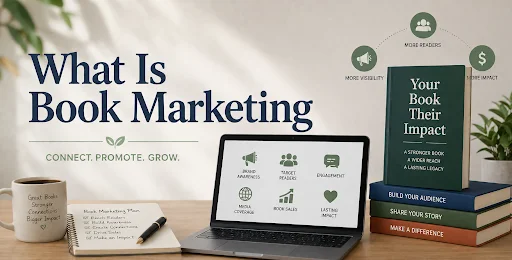
Book marketing is everything an author or publisher does to get a book in front of the right readers and convince them to buy it, separate from the writing and editing itself. It covers the book’s presentation (cover, description, keywords), its visibility (reviews, ads, social proof), and its promotion (email lists, social media, press, events).
Simply: writing is what you say. Marketing is making sure the right people hear it.
A lot of first-time authors assume marketing starts after the book is finished. In reality, the groundwork (audience research, positioning, even early cover concepts) usually starts months before launch, and the strongest marketing plans treat publication day as the middle of the process, not the beginning.
Book marketing isn’t one universal checklist, it changes based on your format and your publishing path, and treating it as one-size-fits-all is exactly why so many first-time authors feel like their efforts aren’t working. Ebooks need algorithmic visibility. Print needs physical presence. Audiobooks need their own discovery channels entirely. And whether you’re traditionally published, self-published, or working with a hybrid publisher, your actual share of the marketing responsibility looks different too.
How Marketing Changes Depending on How You Publish
Traditionally published authors
get some marketing support from their publisher press outreach, catalog placement, sometimes a modest ad budget but publishers spread their attention across an entire season’s list of titles, and debut authors especially tend to get the least support. Even with a traditional deal, most authors still end up doing meaningful marketing themselves: building a personal platform, engaging on social media, and organizing their own local events, since the publisher’s efforts alone rarely carry a book on their own.
Self-published authors
carry the entire marketing load themselves, which is daunting but also means total control over budget, timing, and strategy. Every dollar and hour spent is a direct decision, with no publisher gatekeeping what gets tried, which is really the core of how to market a self published book. The whole load, and thus the whole opportunity, sits with you.
Hybrid-published authors
typically get more structured marketing support than self-publishing alone. A publisher-style team handling some of the heavier lifting (press kits, distribution relationships, sometimes ad management) while the author still drives the overall strategy and, usually, funds a meaningful part of it. This is one of the reasons authors choose hybrid publishing in the first place. At Bookstone Publishers, this is exactly the gap we built our book marketing service around. Pairing an author’s own voice and audience knowledge with a team that handles the technical and logistical side most authors don’t have time to learn from scratch.
The practical takeaway: if you’re traditionally published, your job is to supplement what your publisher is doing, not replace it. If you’re self-published or hybrid, marketing is fully (or mostly) on you, which means the strategies below aren’t optional extras; they’re the whole game.
Marketing an Ebook
Ebooks live and die by algorithmic discovery, more than the other two formats combined. Amazon, Apple Books, and other retailers surface titles based on metadata, keywords, categories, and reader behavior signals like click-through and page-read data (for Kindle Unlimited specifically).
That means your marketing priorities for an ebook are: a strong, keyword-researched book description, correctly chosen categories and keywords so the right readers actually find you in search and browse results; a cover that reads clearly even as a small thumbnail; and a pricing strategy that accounts for how ebook algorithms reward sales velocity, especially in the first days after launch. Limited-time price promotions (through services like BookBub) tend to work specifically well for ebooks because a temporary price drop can trigger a genuine sales spike that the algorithm notices and rewards with continued visibility afterward. Ebook readers also tend to make faster purchase decisions than print buyers, since there’s no shipping wait and often a lower price point, which is exactly why the first impression (cover thumbnail and opening lines of your description) carries so much weight in this format specifically.
Marketing a Print Book
Print marketing leans much more heavily on physical presence and personal connection than algorithmic discovery. Bookstore placement, library availability, in-person events, and word-of-mouth matter enormously here in a way they simply don’t for a digital-only release.
If you’re marketing a print book, a local launch event, a signing, a school or library visit, or getting your book into an actual bookstore (even on consignment) does real work that no amount of social media posting replicates. Print also benefits disproportionately from press coverage, a newspaper feature or podcast mention drives people to search for a physical copy they can hold, browse, or gift, in a way that converts differently than an impulse ebook click. Gifting in particular is a print-specific advantage worth planning around deliberately: holiday seasons, graduations, and other gift-giving occasions consistently drive print sales in a way that barely registers for ebooks, since almost nobody gifts someone a digital file the way they’d wrap a physical book.
Marketing an Audiobook
Audiobooks are now generating more revenue industry-wide than ebooks. Digital audio revenue grew 22.5% to $2.4 billion in 2024, while ebook revenue grew just 1.5% to $2.1 billion, according to the Association of American Publishers’ StatShot Annual report. Audiobook marketing has its own rules: discoverability runs through platforms like Audible, Spotify, and libraries via OverDrive/Libby, and a strong sample (the first few minutes a listener hears before deciding to buy) matters as much as your cover does for print or ebook.
Audiobook listeners also skew toward commute and workout-based listening, which means marketing angles built around routine and habit “perfect for your commute,” “great for long drives” genuinely resonate in a way they wouldn’t for a print or ebook description. Podcast advertising and podcast guest appearances are a particularly strong fit for audiobook marketing specifically, since the audience is already primed to consume audio content.
The Core Strategies That Apply Across All Three
If you’re specifically looking to market your book online, this is that list worth covering, since a complete guide shouldn’t skip it.
Author Platform
A website and an email list are the two assets you actually own, unlike a social media following that a platform algorithm controls. Starting an email list before launch, even a small one, consistently outperforms starting one after, since those early subscribers become your most reliable first wave of reviews and launch-day sales.
Reviews and Social Proof
Early reviews (through ARC teams, editorial review services, or reader outreach) build the credibility that both algorithms and human readers rely on before buying. A book with zero reviews at launch is a much harder sell than one with even a handful of honest ones, since most readers treat review count and star rating as a quick trust shortcut before committing to a purchase.
Social Media
Social media book marketing works best when it’s not spread across everywhere at once. Not every platform suits every genre or every author, and forcing yourself onto a platform that doesn’t fit your book or your personality tends to produce weak, joyless content that readers can sense immediately. Better to go deep on one platform that fits than to spread thin across five and do all of them half-heartedly.
Paid Advertising
Amazon Ads, Facebook/Instagram ads, and BookBub Ads are the most common paid channels, and each rewards patience and testing over big upfront spend. Small, consistent test budgets tend to outperform one large bet, since you learn which keywords, images, or audiences actually convert before committing serious money to any one approach.
Press and Publicity
Local media, podcasts, and niche blogs are far more realistic entry points for most authors than national press, and they often convert better anyway, since the audience is smaller but more targeted. A genre-specific podcast with two thousand engaged listeners often outperforms a brief mention in a general-interest outlet with a much larger but far less relevant audience.
How Do You Know If Your Marketing Is Working?
This is the question almost every guide skips, and it’s arguably more useful than another list of tactics. A few concrete signals are worth watching, format by format.
For ebooks, your KDP dashboard shows sales rank movement and, if you’re enrolled in Kindle Unlimited, page reads, a rising rank after a promotion or ad campaign is a real signal something worked, while a flat rank despite spending suggests the approach needs adjusting rather than more budget. For paid ads specifically, ACOS (advertising cost of sale) tells you whether an ad campaign is actually profitable: general Amazon Ads benchmarks put average ACOS in the 25% to 36% range, according to Ad Badger’s 2026 Amazon Advertising benchmark data, though authors often see a workable range somewhat higher than that, since ebooks carry no printing or inventory cost to eat into the margin. An ACOS above your royalty margin means you’re paying more to acquire a sale than that sale earns you.
For email marketing, open rates and click-through rates are the two numbers worth tracking consistently. The publishing industry averaged a 34.24% open rate in 2025, according to MailerLite’s 2025 email marketing benchmark report — a useful baseline, though a genuinely engaged author newsletter with a reader-opted-in list can often run higher than the broader publishing-industry average, since a reader who subscribed specifically wants to hear from you. A steep decline over time often signals it’s time to refresh your content or segment your list rather than keep sending the same format indefinitely.
For print and audiobook specifically, direct sales data is harder to access in real time, so review velocity (how quickly new reviews accumulate after a push) and library hold counts (through OverDrive/Libby, where available) serve as reasonable proxy signals for whether interest is building.
The honest point here: marketing without measurement is just spending. Even simple, consistent tracking lets you double down on what’s working and stop pouring time into what isn’t, rather than guessing.
Should You Hire a Book Marketer, or Do It Yourself?
At some point, most authors ask the same question: hire a book marketer, or handle it alone? There’s no universal right answer, but a few things help decide it. If you’re working with a tight timeline, several books to promote at once, or simply don’t have the hours to learn ad platforms and email tools from scratch, professional book marketing services can genuinely pay for themselves in time saved alone.
When it comes to platforms where authors hire book marketers, three options come up most often: freelance marketplaces like Fiverr and Upwork, or full-service publishing companies that fold marketing into a broader package alongside editing and design. Pricing varies enormously across all three. There are genuinely affordable book marketing services built for tight budgets, and there are agencies like Bookstone Publishers offering some of the best book marketing services in the industry for authors who want full, hands-on execution rather than a self-managed campaign. If you decide to go the DIY route instead, everything in this guide still applies.
And if you want help building a marketing plan that actually fits your book’s format and your publishing path, that’s exactly the kind of strategy Bookstone Publishers has with authors regularly because a generic marketing checklist was never going to work as the one built around your specific book.
Common Mistakes First-Time Authors Make
A few patterns come up often enough to name directly. The first is waiting until publication day to start any marketing at all; by then, you’ve lost months of possible email list growth and audience-building. The second is treating every format the same way, running one generic campaign across print, ebook, and audiobook instead of adjusting the approach as outlined above. The third is over-relying on social media while neglecting an email list, which is a mistake because you don’t own your social following the way you own an email list, a platform policy change or algorithm shift can erase your reach overnight, while an email list stays entirely yours. The fourth is giving up after one underwhelming launch week, when in reality most successful author careers are built on cumulative effort across multiple books and months of steady, unglamorous groundwork rather than one dramatic release.
How to Market a Book: A Simple Framework to Start With
If all of this feels like a lot at once, here’s a simplified book marketing plan you can follow in sequence. Three to six months before launch, build your author platform (website, email list) and start planning your ARC team. One to two months before launch, finalize your book’s metadata, keywords, and categories, and line up early reviews. At launch, run your format-specific push, a price promotion for ebooks, an event or press outreach for print, podcast placements for audiobooks. After launch, shift into sustained, lower-effort maintenance: continued email engagement, occasional promotions, and building toward your next book. However you approach how to market your book, remember that long-term author careers are built book over book, not from one launch alone.
Frequently Asked Questions
What is book marketing in simple terms?
Book marketing is everything an author does to get their book noticed and purchased by readers, separate from writing and editing. It covers the book’s presentation, visibility, and promotion across whichever formats and channels apply.
How do I start marketing my book if I’ve never done it before?
Start with your author platform (a simple website and an email list) a few months before launch, then move into format-specific tactics keyword optimization for ebooks, events for print, podcast placements for audiobooks as your launch date approaches.
Is book marketing different for ebooks versus print books?
Yes, significantly. Ebooks rely heavily on algorithmic discovery through keywords, categories, and pricing strategy, while print benefits more from physical presence bookstore placement, events, and press coverage that drives people to seek out a physical copy.
Do I need to market an audiobook differently than an ebook?
Yes. Audiobook discovery runs through different platforms (Audible, Spotify, library apps), and audiobook marketing benefits especially from podcast placements and messaging built around commute or workout listening habits.
Does a traditionally published author still need to do their own marketing?
Usually, yes. Publishers provide some support, but it’s often limited, especially for debut authors, and most traditionally published authors still handle a meaningful share of their own platform-building and promotion.
How do I know if my book marketing is actually working?
Track format-specific signals rather than guessing: sales rank movement and ACOS for ebooks and ads, open and click rates for email, and review velocity or library holds for print and audiobooks. Consistent, simple tracking beats spending more without measuring results.