
Every author eventually runs into this question, usually right around the time the manuscript is finished and the real decisions start: should this book come out as an ebook, a print book, or both? Search around for an answer and you’ll mostly find the same shrug “just do both, why not” without much explanation of when that’s actually true, and when it isn’t.
Here’s the honest version. Print still dominates the market by a wide margin, ebooks have quietly plateaued, and audiobooks are the one format nobody talks about enough, despite growing faster than either of the other two. The right answer for your book depends on your genre, your budget, and what your readers actually do, not just what feels safe to assume.
The Quick Verdict
If you can genuinely afford it, publish in all three formats (print, ebook, and audiobook). Readers are increasingly format-loyal in surprising ways, and each format reaches a meaningfully different buyer. But if budget or time forces you to prioritize, the right first format depends heavily on genre, which we’ll get into below.
If you want help thinking through the right format strategy and budget for your specific book, that’s exactly the kind of planning conversation Bookstone Publishers has with authors regularly. Including full-service ebook, print, and audiobook production under one roof, so you’re not coordinating three separate vendors to do it right.
What the Data Actually Shows
The clearest evidence comes from the Association of American Publishers’ (AAP) StatShot Annual report, which tracks reported revenue from roughly 1,300 U.S. publishers. In 2024, digital audio (audiobook) revenue grew 22.5% year over year to $2.4 billion, while ebook revenue grew just 1.5% to $2.1 billion, meaning audiobooks have already overtaken ebooks in raw revenue, and the gap is widening, not narrowing.
Zoomed out across the full trade market, print still holds the largest share by a wide margin, roughly 78.5% of US trade book revenue in 2025, with ebooks at about 10% and audiobooks at approximately 11.5%. Print’s dominance hasn’t budged much in a decade, but the order of the other two has quietly flipped.
On usage rather than revenue, a 2025 YouGov reading habits survey found print still leads at 46% of US adults, with ebooks at 24% and audiobooks at 23% , nearly tied, and audiobooks are the fastest-growing of the three by a comfortable margin.
The Case for Print
Print isn’t just nostalgia. It’s genuinely still what most readers reach for first, and it comes with real practical advantages a lot of authors underestimate.
Bookstores, in-person events, and signings only work with a physical product. If you’re planning any kind of local launch, a school visit, a conference talk, or a library reading, print is non-negotiable; there’s no ebook equivalent of handing someone a signed copy. Print also tends to be the default choice for certain genres almost automatically: cookbooks, illustrated children’s books, coffee table books, and heavily designed nonfiction all lose something real in a digital-only format, where page layout and print quality genuinely matter to the reading experience.
There’s also a resale and gifting dimension digital formats simply can’t replicate. A print book can be lent, gifted, sold secondhand, or donated to a library. Each of those is a small extra distribution channel that doesn’t exist for an ebook file tied to someone’s personal account.
The Case for Ebooks
Ebooks solve a different problem: convenience and lower cost per unit for the reader, along with genuinely lower production overhead for the author.
Because there’s no printing, shipping, or physical inventory involved, ebooks tend to carry a lower price point, which some genres respond to strongly. Romance, thriller, and fast-paced genre fiction readers are often heavy digital consumers. Many of them read far more books per year than the average print reader, precisely because ebooks are quick to buy and instantly available. If a reader finishes your book at 11 p.m. and wants the sequel immediately, only a digital format delivers that.
Ebooks are also the format most authors can produce fastest and cheapest, since the manuscript itself is nearly ready to go once editing and formatting are complete. No print proofing, no physical run, no shipping delay.
The Case for Audiobooks
Audiobook listeners are often a genuinely different audience than either print or ebook readers. People who “read” during commutes, workouts, or chores, and who otherwise might not make time for your book at all. For genres like memoir, narrative nonfiction, and thriller, a well-narrated audiobook can meaningfully expand your total audience rather than just splitting an existing one across formats.
The tradeoff is production complexity. Unlike an ebook, an audiobook needs a narrator, a recording and editing process, and typically runs $150 to $400 per finished hour of professional narration. An 80,000-word novel produces roughly 8 to 10 finished hours of audio, so a full professional narration typically lands somewhere between $1,500 and $4,000. A genuinely different cost structure than either print or ebook production.
We recently helped a narrative nonfiction client launch in ebook and audiobook formats simultaneously, and the audiobook edition ended up outperforming the ebook in total units within the first few months.
Who Actually Buys Each Format, and When?
Format choice isn’t really about picking a single loyal reader type. Most frequent readers are what the industry calls hybrid readers, people who buy across formats depending entirely on the situation they’re in, not a fixed preference.
A single reader might buy the print edition to keep on a shelf or read at home on a weekend, switch to the ebook while traveling with limited luggage space, and queue up the audiobook for a daily commute or a workout. None of that is contradictory; it’s the same reader, buying the format that fits the moment. Practically, this means a book available in all three formats isn’t just hedging your bets across different readers but also it’s capturing more total purchases from the same engaged readers who would have bought a second or third format anyway, if you’d made it available.
Does Genre Actually Change the Right Answer?
Yes, meaningfully so. Here’s a rough guide to how format preference tends to split by genre, based on current reader behavior patterns:
| Genre | Format That Tends to Lead | Why |
| Romance | Ebook + Audiobook | Fast reading pace, frequent purchases, strongly digital-native readership |
| Sci-Fi / Paranormal Fiction | Ebook + Audiobook | Long-documented strong adoption by digital-first readers in this category |
| Fantasy (epic / collectible) | Print + Ebook | Series collectors often want physical editions alongside digital convenience |
| Thriller / Mystery | Ebook + Audiobook | High page-turn speed and strong audiobook listener overlap |
| Memoir / Narrative Nonfiction | Audiobook + Print | Personal voice narration adds real value; print favored for gifting |
| Children’s / Picture Books | Illustration and page layout don’t translate well to any digital format | |
| Business / Self-Help | Audiobook + Ebook | Often consumed during commutes or workouts; less often given as physical gifts |
| Cookbooks / Illustrated Nonfiction | Layout, photography, and usability depend on the physical page |
If your book falls cleanly into one of these categories, that’s a reasonable place to prioritize your first format. If it straddles two, that’s usually a sign you’d benefit from launching in both from day one.
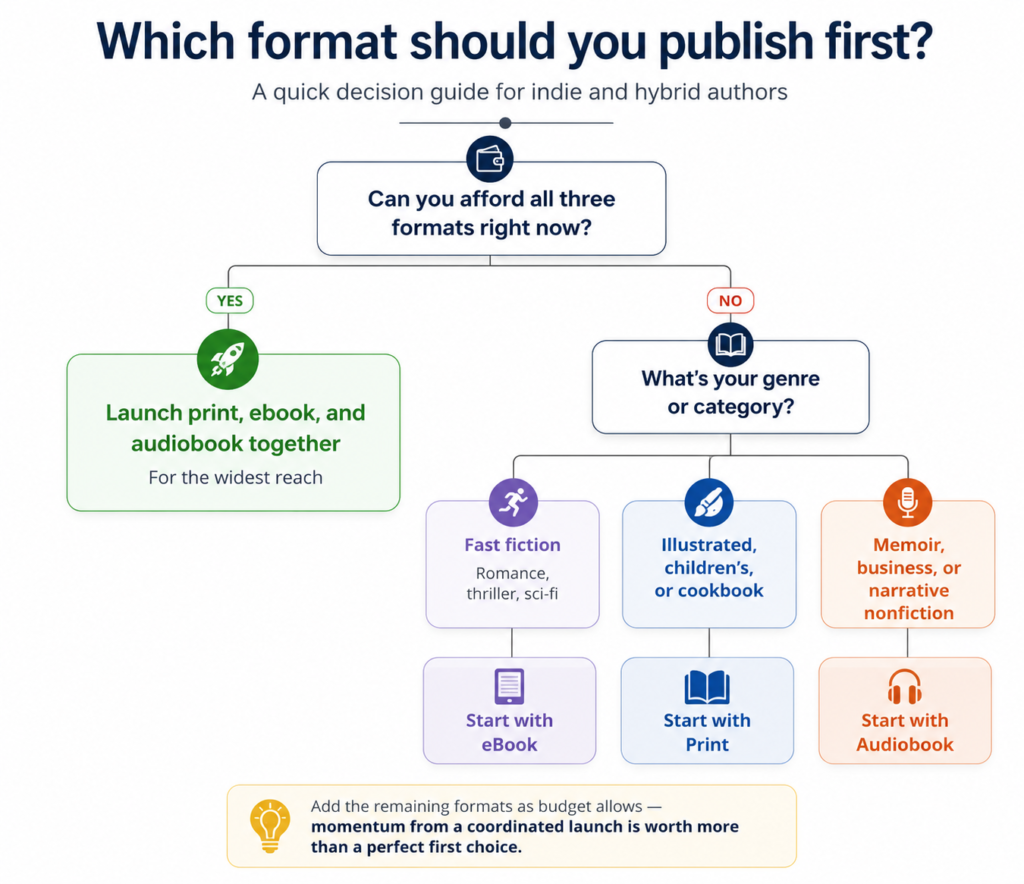
A Simple Decision Flowchart
If you’d rather see this as a quick visual than read through the reasoning again, here’s the same logic laid out as a decision path.
What Each Format Actually Costs to Produce?
This is where a real budget conversation matters, since “just publish everywhere” is easy advice to give and harder to actually fund.
Ebook production
Ebook production is the cheapest by a wide margin. Once your manuscript is edited, formatting for Kindle, Apple Books, or other digital retailers typically costs little to nothing extra if you’re using free tools, or a few hundred dollars for professional formatting on a complex layout.
Print production
Print production through print-on-demand carries no upfront cost. You only pay a per-copy printing fee that’s deducted from each sale. Bulk printing costs more upfront but lowers your per-unit cost if you’re planning events or bulk sales.
Audiobook production
Audiobook production is the most expensive per project, typically running $1,500 to $4,000+ for a full-length novel narrated by a professional, as noted above. Some authors offset this with a royalty-share arrangement instead of an upfront fee, though that usually means splitting audiobook royalties with your narrator for several years afterward.
One Cost that Catches First-time Authors Off guard
each format technically needs its own ISBN if you’re distributing beyond a single platform. A print edition, an ebook edition, and an audiobook edition are treated as three separate products, each requiring a separate ISBN if you’re buying your own through Bowker (roughly $125 for a single ISBN, or $295 for a pack of ten, which is usually the more economical choice once you’re publishing in multiple formats). Platforms like Amazon KDP will issue free ISBNs for ebooks and print, but audiobook distribution through ACX or similar platforms often has its own identifier system, worth confirming before you assume one ISBN covers everything.
A Simple Way to Decide, If You Can’t Do All Three at Once
If the budget forces you to launch with just one format first, ask three questions. What does my genre’s audience actually consume most? What can I realistically afford right now? And what does my own launch plan require? A bookstore event genuinely needs print, while a podcast-driven launch might lean harder into audiobooks.
For most fiction, ebook first is the lowest-risk starting point, since it’s the cheapest to produce and fastest to get live. For illustrated or highly visual nonfiction, print has to come first, since the format itself doesn’t work any other way. For memoir, business books, and narrative nonfiction with a strong authorial voice, audiobooks are worth prioritizing earlier than most authors assume, given how much that revenue share has grown. This is a big part of why Bookstone Publishers builds format strategy into the very first planning conversation with a new author, rather than treating it as an afterthought once editing is already finished.
There’s no universal right answer to ebook versus print versus audiobook. Print remains the dominant format overall and is non-negotiable for certain genres. Ebooks remain the cheapest, fastest format to produce and reach fast-reading digital audiences well. Audiobooks are the format most still ignore, despite now out-earning ebooks industry-wide and for the right genre, they may deserve more of your budget than you’d assumed going in.
Frequently Asked Questions
Do authors make more from ebooks or print books?
It depends on the path. Self-published authors often net more per ebook sale since there’s no printing cost deducted from the royalty. Traditionally published authors sometimes see the opposite, since standard ebook royalties (often around 25% of net receipts) can be lower in raw dollar terms than print royalties on higher-priced hardcovers.
Do authors make more from ebooks or print books?
It’s the observation that roughly 90% of a publisher’s revenue tends to come from just 10% of its titles, typically established bestsellers. For most authors, it’s a reminder that consistent marketing and audience-building matter more than hoping a single book carries outsized success on its own.
Should I publish an ebook or print book first?
For most fiction, especially fast-paced genres like romance or thriller, ebook first is the lower-risk, lower-cost starting point. For illustrated nonfiction, children’s books, or anything design-dependent, print needs to come first since the format itself requires it.
Is it worth making an audiobook for a first book?
Often yes, especially for memoir, business, or narrative nonfiction. Genres where audiobooks now out-earn ebooks industry-wide. The upfront cost is higher than ebook production, so weigh it against your specific genre and budget rather than treating it as automatic.
Does offering all three formats increase total sales, or just split the same readers?
Industry data suggests it genuinely expands your audience rather than just splitting it. Audiobook listeners, ebook readers, and print buyers often behave as distinct audiences with real overlap but real differences too.
Can I add a format later if I only launch with one?
Yes, and many authors do exactly this. A coordinated launch across formats tends to generate more attention and reviews than a quiet addition months later. If budget forces a staggered approach, plan the second format’s release around a specific moment (a sale, an anniversary edition, a series milestone) rather than letting it slip out unannounced.