You finished your manuscript. That’s a real accomplishment, most people who start a book never get to the last page. But if you’ve opened your document, reread the first chapter, and felt a small wave of panic about everything that still needs fixing, you’re not alone. Editing is where most first-time authors get stuck, mostly because nobody explains what “editing a book” actually involves.
It’s not one task. It’s a sequence of distinct passes, each looking for different problems, done in a specific order. Skip a step or do them out of order, and you’ll waste time polishing sentences in a chapter you end up cutting entirely.
This guide walks through exactly how to edit a book, the self-editing steps you can do yourself, where those steps run out of road, and how to figure out when it’s time to hire a professional book editor.
What Does “Editing a Book” Actually Involve?
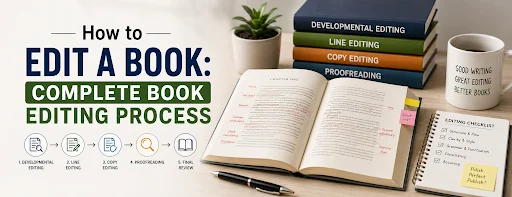
When most new authors hear “editing,” they picture someone circling typos in red ink. That’s proofreading, and it’s the last step in the process, not the first. A full edit moves through four editing types:
- Developmental editing looks at the big picture: plot structure, pacing, character arcs, argument flow (for nonfiction), and whether the book delivers on what it promises the reader.
- Line editing works at the sentence and paragraph level; voice, rhythm, clarity, and how the writing actually reads.
- Copyediting checks grammar, consistency, and technical accuracy: timeline errors, name spellings, style-guide adherence.
- Proofreading is the final pass before publication, catching leftover typos, formatting issues, and small errors that survived every earlier round.
Here’s the part that surprises most authors: you generally can’t do these out of order. There’s little point line-editing a chapter’s prose if a developmental pass is going to cut that chapter entirely. Each stage exists to catch a different category of problem, and doing them in sequence; big picture first, small details last saves an enormous amount of wasted effort.
Not every manuscript needs all four as separate professional passes. But every manuscript needs all four addressed somewhere before it’s ready for readers.
Step-by-Step: How to Self-Edit Your Manuscript First
Before you think about hiring anyone, there’s real, valuable work you can do yourself. A clean self-edit makes any later professional pass faster and cheaper, because the editor isn’t spending time on issues you could’ve caught.
Step 1: Let the manuscript rest before editing.
Put the draft away for at least two to four weeks after finishing it. This isn’t optional, you cannot edit objectively while you’re still holding the entire story in short-term memory. Distance is what lets you read your own writing the way a stranger will.
Step 2: Do a structural pass first.
Read the whole manuscript start to finish without touching a single sentence. Take notes instead: Does the pacing sag in the middle? Does a character disappear for 100 pages and reappear with no explanation? Does the argument in chapter six contradict the one in chapter two? This is your own developmental pass, and it comes before anything else.
Step 3: Edit for language, rhythm, and voice.
Now go sentence by sentence. Read for repetition (favorite words, overused sentence structures), pacing within scenes, and whether the voice stays consistent. Reading a chapter aloud is one of the fastest ways to catch the clunky rhythm your eyes skip over on the page.
Step 4: Run a grammar and consistency check.
Use a grammar tool to catch mechanical errors, but treat it as a first filter, not a final answer. These tools flag surface issues and regularly miss context, tone, and factual consistency (a character’s eye color changing between chapters, a timeline that doesn’t add up). Keep a style sheet tracking names, spellings, and formatting choices as you go.
Step 5: Read it aloud or use text-to-speech.
This step catches what silent reading misses. Awkward phrasing, missing words, and run-on sentences almost always announce themselves the moment you hear them spoken.
Do all five steps well, and you’ll hand off a noticeably stronger manuscript whether to an editor, a group of beta readers, or straight to publication.
Where Self-Editing Hits Its Limits
Here’s the problem no amount of diligence solves: you already know how the story ends. You know what the character was thinking even if it never made it onto the page. You know what point chapter nine is building toward, even if a reader would get lost halfway through. This is sometimes called “editor blindness,” and it isn’t a skill gap, it’s a structural limitation of editing your own work. Every writer has it, including professional novelists on their fifth published book.
This is exactly the gap a second set of trained eyes closes. An outside editor reads the manuscript the way your actual audience will: without the context that only exists in your head. That’s why traditionally published books rarely skip a professional editorial pass, even when the author is already an experienced writer, the objectivity a professional editor brings isn’t replaceable by re-reading your own work more carefully.
This is where working with an experienced editorial team, like the one at Bookstone Publishers, tends to make the biggest difference for self-published authors: not because self-editing was done poorly, but because no author can fully see their own blind spots.
Consider a common example: a subplot that felt essential while you were writing it, because you knew where it was headed and why it mattered to the larger story. A reader encountering it cold has none of that context. They just experience 30 pages that don’t seem to connect to anything. You can reread that subplot ten times and still see the version in your head instead of the version on the page; that’s editor blindness in action, and it’s precisely the kind of issue a developmental edit is built to catch.
DIY Editing vs. Hiring a Professional Edito
Both paths can produce a good book. The right choice depends on your budget, timeline, and how much objectivity your manuscript still needs after your own passes.
| Self-Editing Only | Professional Editing | |
| Cost | Free (your time) | Paid, varies by editing type and manuscript length |
| Objectivity | Limited editor blindness is unavoidable | High — an outside reader catches what you can’t |
| Structural feedback | Difficult to assess your own plot/argument gaps | Trained to spot pacing, structure, and logic issues |
| Time investment | Weeks to months, done in spare time | Faster turnaround, run in parallel with other publishing steps |
| Quality ceiling | Capped by your own editing skill | Raised by a trained editor’s expertise |
| Best for | Tight budgets, early drafts, practice manuscripts | Manuscripts headed for publication |
A useful way to think about it: self-editing sharpens the manuscript you can see. Professional editing catches the manuscript you can’t. Most published authors, traditionally and independently use both, in that order.
What to Look for When Hiring a Book Editor
If you decide to bring in a professional, not every editor is the right fit for every book. Here’s what actually matters when evaluating one.
Credentials and editing samples
Ask for a sample edit of a few pages before committing to a full manuscript. This tells you more than any bio or testimonial, you’ll see exactly how they think and how they communicate feedback.
Genre experience.
An editor who specializes in literary fiction may not be the right fit for a fast-paced thriller or a business nonfiction book. Ask what they’ve edited recently in your genre or category.
Editing process and timeline.
A professional editor should be able to explain their process clearly: how many passes, what each pass covers, and a realistic timeline based on your manuscript’s length.
Pricing transparency.
You should get a clear quote based on word count and editing type before work begins, not a vague estimate that changes halfway through.
This is one of the areas where a full-service publisher has an advantage over a single freelancer: at Bookstone Publishers, manuscripts are matched with editors experienced in that specific genre or category, with the process and pricing laid out before anything starts.
It’s also worth asking how feedback is delivered. Some editors work entirely through tracked changes and margin comments; others include a summary editorial letter covering the manuscript’s overall strengths and weaknesses. Neither approach is wrong, but knowing which one you’re getting and confirming it matches how you prefer to receive feedback, makes the revision process afterward much smoother.
How Much Does It Cost to Edit a Book?
Editing costs vary widely depending on the type of edit, the manuscript’s length, and the editor’s experience level. As a general rule, developmental editing costs more per word than copyediting or proofreading, because it demands more time and deeper analytical work from the editor. Line editing typically falls in the middle.
Rather than shopping by price alone, it’s worth requesting a quote based on your specific manuscript’s word count and the editing depth it needs; a 50,000-word memoir and a 120,000-word fantasy novel require very different amounts of editorial time, even if the per-word rate looks similar on paper.
It’s also worth asking whether a quote covers a single pass or includes a follow-up round after you’ve made revisions. Some editors build a second, lighter pass into their pricing to confirm earlier feedback was implemented cleanly; others charge separately for it. Knowing this upfront prevents budget surprises halfway through the process, and it’s a fair question to ask any editor or publisher before signing on.
If your budget is limited, it’s usually smarter to spend on a developmental edit before a copyedit, not after. A brilliantly copyedited manuscript with a structural problem is still a manuscript with a structural problem just one that reads smoothly on the way to that problem. Fix the foundation first, then polish.
How Long Does Editing a Book Take?
Timeline depends on manuscript length and how many editing passes you need. As a rough guide:
- Self-editing (Steps 1–5 above): 1–3 months, depending on manuscript length and how much time you can dedicate weekly.
- Professional developmental edit: Several weeks for a full-length manuscript, since this pass requires deep analytical reading.
- Line edit and copyedit: Typically faster than a developmental pass, but still requires careful, unhurried attention.
- Proofreading: The shortest pass, usually completed in days rather than weeks.
Build editing time into your overall publishing timeline early, authors who treat editing as an afterthought squeezed in before a launch date are the ones most likely to publish a book that needed one more pass.
A helpful way to plan backward: pick your target publication date, then work in reverse. Proofreading needs to finish with enough buffer for formatting and cover design. Copyediting needs to finish before proofreading starts. Line editing comes before that, and developmental editing before that. Mapped out this way, most authors are surprised how far in advance the editing process actually needs to begin; often four to six months before a planned launch, once self-editing, professional passes, and revision time are all accounted for.
Final Checklist Before You Consider Your Book “Publish-Ready”
Before you move on to formatting and publishing, confirm you’ve covered:
- A completed structural/developmental pass either your own or a professional’s
- A line edit for voice, clarity, and rhythm
- A copyedit for grammar, consistency, and technical accuracy
- A final proofread after all other changes are made
- A style sheet documenting names, spellings, and formatting choices
- At least one read-aloud or text-to-speech pass
- Feedback from at least one outside reader, ideally a professional editor
If you can check every box, your manuscript has been through the process that separates a rough draft from a publish-ready book.
Ready for a Second Set of Eyes?
Every manuscript benefits from an outside perspective, the question is just how much editing your book needs before it’s ready for readers. If you’re not sure where your manuscript stands, Bookstone Publishers offers a free manuscript assessment to identify exactly which editing stages your book needs next.
Frequently Asked Questions
How do I edit my own book if I can’t afford a professional editor?
Start with the five self-editing steps: rest the manuscript, do a structural pass, edit for voice and rhythm, run a grammar check, and read it aloud. Beta readers can also provide valuable outside perspective at no cost, even without professional credentials.
What’s the difference between developmental editing and copyediting?
Developmental editing addresses big-picture issues; structure, pacing, and argument flow. Copyediting comes later and focuses on grammar, consistency, and technical accuracy. They solve different problems and typically happen in separate passes.
Can AI tools replace a human book editor?
AI and grammar-checking tools are useful for catching surface-level errors, but they miss context, tone, and structural issues a trained human editor identifies. Most authors use them as a first filter, not a replacement for professional editing.
How much should I budget to edit a book?
Cost depends on the editing type, manuscript length, and editor experience. Developmental editing typically costs more per word than copyediting or proofreading. Request a quote based on your specific word count for an accurate estimate.
How long does professional editing take for a full-length novel?
A developmental edit for a full-length novel can take several weeks; line editing and copyediting are usually faster. Total timeline depends on manuscript length and how many editing passes your book needs.