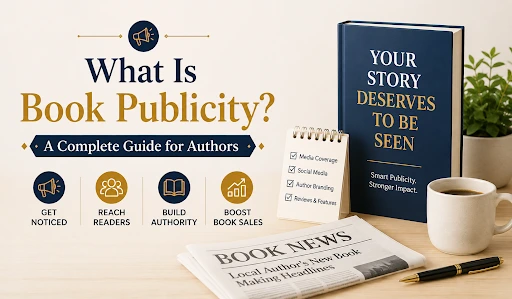
Book publicity is the practice of earning media coverage for a book through journalists, podcast hosts, and reviewers, rather than paying for placement directly. It differs from marketing, which is paid and controlled, and from advertising, which is purchased outright. Author publicity typically starts four to six months before publication and continues well past launch day, since earned coverage has no fixed timeline.
Almost every author hears the word publicity at some point and nods along, without quite being sure what it actually means or whether their book needs it. That confusion is common, and honestly, understandable. Publicity gets used loosely to describe everything from a podcast interview to a Facebook ad, and the two are not the same thing at all.
This guide breaks down what book publicity actually is, how it differs from marketing and advertising, what a realistic publicity timeline looks like, and how to decide whether hiring help makes sense for your book.
How Does Book Publicity Help Authors?
Book publicity earned media coverage. It is the process of getting journalists, podcast hosts, bloggers, and reviewers to talk about your book on their own platform, in their own words, because they genuinely found it worth covering.
One publicity firm defines it plainly, describing publicity as earned media coverage similar to the press outreach side of public relations, adding that it is not advertising, and it is not sales. That distinction matters more than it sounds like it should, because the mechanics of earning coverage are completely different from buying it.
A book publicity campaign is a strategic promotional effort designed to generate awareness, interest, and sales for a book, and it typically runs both before and after a book’s release rather than existing as a single event. The word campaign is doing real work there. Publicity is rarely one press release or one interview. It is a sustained effort across weeks or months.
Book Publicity vs. Marketing vs. Advertising
These three terms get used interchangeably by a lot of authors, and that mixing up is where most confusion starts. Each one operates on a different set of rules.
| Publicity | Marketing | Advertising | |
| What it is | Earned media coverage | Owned and paid promotion | Paid placement only |
| Control | Low, media decides | High, you decide | High, you decide |
| Guaranteed result | No | Mostly, once purchased | Yes, once purchased |
| Cost structure | Fee for effort, not placement | Varies by channel | Pay per placement or click |
| Perceived credibility | High, third party endorsed | Moderate | Lower, known as an ad |
As one publicist put it plainly, comparing the two is like saying butter and margarine are the same thing, which they are not. Publicity depends entirely on whether a journalist or host decides your book is worth their audience’s time. Marketing and advertising do not carry that same uncertainty, since you are paying directly for the placement, the timing, and the message.
That tradeoff cuts both ways. Publicity carries a credibility that paid placement cannot buy, since a reader trusts a journalist’s independent recommendation more than an ad, but it also comes with zero guarantee that any specific pitch lands.
Book publicity is not marketing, it is not advertising, and it is not guaranteed. It is the slower, less predictable, but often more credible work of earning coverage because your book genuinely deserves the attention. Understanding that distinction early changes how you plan, how you budget, and how patient you need to be with the results.
Why Author Publicity Still Matters
It would be easy to assume that in a world of social media and self publishing, earned media has lost its relevance. That is not what the data or the industry suggests. Even a book from a major publisher nearly always needs real promotion to succeed, and competition for media attention keeps intensifying as more books are released every year than ever before.
Author publicity also builds something advertising cannot. When a journalist, podcast host, or reviewer chooses to cover your book, that choice signals to their audience that the book earned their attention. That kind of third party validation is very difficult to manufacture through paid channels, no matter the budget behind them.
What Book Publicity Services Typically Include
If you hire a publicist or work with a full service book publicity services provider, the scope of work usually breaks down into several connected pieces rather than one single task.
- Building a targeted media list of journalists, podcasters, and reviewers who cover your genre or subject
- Writing pitches and press materials, including a press release and author bio
- Securing advance reviews from trade publications and independent reviewers ahead of launch
- Booking interviews, podcast appearances, and speaking opportunities
- Coordinating launch week coverage so momentum lands around the actual release date
- Continuing outreach after launch, since coverage often lands weeks or months later
It is worth knowing that results in this industry are never promised as a fixed number of placements, since no publicist controls an editor’s calendar. What a good publicist actually controls is effort, relationships, and the quality of the pitch, not the outcome itself.
An Honest Look at Book Publicity Timeline Expectations
Timing trips up more authors than almost any other part of this process. Publicity does not start the week your book comes out. By then, most of the opportunity has already passed, since many outlets plan coverage months in advance.
| Timing | What Happens |
| 6 to 8 months before pub date | Publicist or author builds a media list, drafts pitches, and secures early reviews |
| 3 to 4 months before | Advance reader copies go out, longer lead media like magazines get pitched |
| 4 to 6 weeks before | Podcast bookings, shorter lead outlets, and local media get pitched |
| Launch week | Interviews air, reviews post, and confirmed media coverage lands |
| After launch | Ongoing pitching continues, since coverage can land months later |
One industry insider with over two decades in publishing offers a useful reality check here too, noting that so-called announced first printing numbers are often inflated well beyond the actual print run, since that figure is really a sales target dressed up as a fact. Publicity teams then treat that number as a signal for how aggressively they need to secure confirmed coverage early, not just hoped for coverage.
The practical lesson for authors is this. If you are planning to pursue any kind of author publicity, start thinking about it while you are still finishing the manuscript, not after the book is printed. Waiting until launch week to start pitching is one of the most common and costly mistakes first time authors make.
Do You Need to Hire a Publicist, or Can You DIY
Not every author needs to hire professional book publicity services, but every author benefits from understanding how the process works before deciding. A few honest questions can help clarify which path fits.
- Do you already have relationships with journalists, podcast hosts, or reviewers in your genre
- Do you have the time to research contacts and write personalized pitches consistently for months
- Is your budget better spent on hired expertise or on your own time investment
- Does your book have a clear hook or newsworthy angle that makes pitching easier
Authors with an existing platform, a clear media hook, and time to spare often do reasonably well running their own outreach. Authors without those things, or without the time to learn the process from scratch, tend to get more value from hiring someone who already has the relationships and knows how editors think.
At Bookstone Publishers, this is exactly the kind of planning we walk authors through well before launch day, matching realistic publicity strategy to the book and the timeline rather than promising placements no one can actually guarantee. If you are still deciding what your own publicity plan should look like, our team can help you build one that fits your book.
Common Mistakes Authors Make With Publicity
- Starting outreach the week of launch instead of months earlier
- Pitching every outlet the same generic message instead of a tailored angle
- Expecting guaranteed coverage instead of understanding publicity is earned, not purchased
- Ignoring podcasts and newsletters in favor of only chasing traditional print or TV coverage
- Stopping outreach right after launch week instead of continuing for months afterward
That last point deserves emphasis. Coverage from a pitch sent in month one can land in month four. Treating publicity as a short sprint around launch day, rather than a sustained effort, is one of the most common reasons authors feel their publicity underperformed when the real issue was timing and persistence.
Frequently Asked Questions
What is book publicity in simple terms?
Book publicity is the process of earning media coverage for a book through journalists, podcast hosts, and reviewers, rather than paying directly for that coverage the way you would with advertising.
How is book publicity different from book marketing?
Publicity is earned coverage with no guaranteed placement, while marketing is paid or owned promotion where you control the message, timing, and where it appears.
When should author publicity start?
Publicity should start four to six months before a book’s release, since many outlets plan their coverage well in advance and rarely accommodate last minute requests.
Do I need to hire book publicity services?
Not necessarily. Authors with existing media relationships and time to pitch consistently can run their own outreach, while others benefit from hiring a publicist who already has those relationships.
How long does a book publicity timeline usually last?
A typical timeline runs from about six months before launch through several months after, since earned coverage can land well past the release date.
Is book publicity guaranteed to increase book sales?
No. Publicity is not guaranteed, since media outlets decide independently what to cover, though earned coverage tends to carry more credibility with readers than paid advertising.
What is the difference between publicity and advertising for authors?
Advertising is purchased placement with guaranteed results once paid for, while publicity depends on a journalist or host choosing to cover your book with no payment involved.