
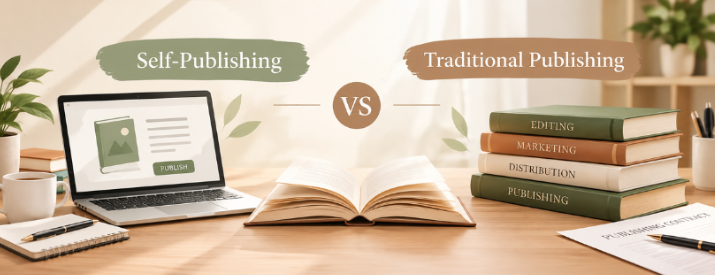
Neither is universally better, it depends on what you’re optimizing for. Traditional publishing offers an advance, shared financial risk, and easier access to bookstores and media, but takes one to three-plus years and pays lower per-copy royalties. Self-publishing gets your book live in weeks, keeps full rights and higher royalties, but requires upfront costs (typically $1,500–$5,000+) and full control of production and marketing. Hybrid publishing splits the difference for authors who want professional support without the long timeline, as long as the hybrid publisher is legitimately selective, not a vanity press in disguise.
You finished your manuscript. That’s the hard part, or at least you thought it was, until you started researching what comes next and found a dozen conflicting opinions about how to actually get your book into readers’ hands.
Here’s the truth: the old assumption that “traditional publishing means legitimate, self-publishing means amateur” doesn’t hold up anymore. Self-published authors regularly outsell traditionally published ones. Traditional publishers have gotten more selective and slower, not less. And a third option hybrid publishing has muddied the water even further, promising the best of both worlds while sometimes delivering the worst.
So instead of another article defining terms you probably already know, this one is built to answer the question you’re actually asking: which path fits you: your budget, your timeline, your goals, and how much control you want to keep. By the end, you’ll have real cost numbers, realistic timelines, and a framework for deciding, plus an honest look at whether hybrid publishing is worth considering.
What’s the Real Difference Between Self-Publishing and Traditional Publishing?
Strip away the jargon and the difference comes down to one question: who pays whom?
In traditional publishing, a publisher pays the author, usually through an advance against future royalties and in exchange, the publisher owns the rights to produce and distribute the book for a set term. The publisher covers editing, cover design, printing, and distribution, and takes on the financial risk if the book doesn’t sell.
In self-publishing, the author pays for everything including editing, design, formatting, distribution, marketing and in exchange keeps full ownership of the rights and the vast majority of the royalties. The author takes on the financial risk, but also keeps the upside if the book performs well.
Hybrid publishing sits in between: the author typically pays some costs, but a publisher provides professional services, an imprint, and distribution support in return. We’ll come back to this, because it’s not always what it claims to be.
The point worth internalizing early: the difference isn’t really about book quality or credibility anymore. It’s about who takes on financial risk, and who keeps control.
How Traditional Publishing Works in 2026
Finding a Literary Agent
For most genres, traditional publishing starts with querying literary agents, not publishers directly. That means writing a query letter, sending it to dozens (sometimes hundreds) of agents, and expecting the vast majority to pass. Rejection rates are steep, this stage alone can take months to over a year, and there’s no guarantee of a yes at the end of it.
The Submission-to-Publishers Stage
Once an agent signs you, they pitch your manuscript to publishing houses on your behalf. If a publisher makes an offer, negotiations begin over the advance, rights, and contract terms. This stage can take several more months.
Advances, Royalties, and What the Publisher Handles
If a deal happens, you typically receive an advance paid in installments, plus royalties once the book earns out that advance. In return, the publisher handles editing, cover design, printing, and distribution and traditionally, some marketing, though publisher-funded marketing budgets for debut or midlist authors have shrunk significantly in recent years, with many authors expected to handle a meaningful share of promotion themselves.
Realistically, the timeline from a finished manuscript to a book on shelves commonly runs one to three years, sometimes longer. If you’re optimizing for speed, this is the slowest of the three paths but it’s also the only one where someone else shares your financial risk.
How Self-Publishing Works in 2026
Platforms and Distribution
Self-publishing today happens through a mix of ebook and print-on-demand platforms, audiobook distributors, and increasingly, direct-to-reader storefronts. The technical barrier to publishing something is nearly zero, the real work is everything around it.
What You’re Responsible For
As a self-published author, you’re the publisher. That means sourcing (and paying for) developmental and copy editing, cover design, interior formatting, ISBN registration, metadata and keyword optimization, and a marketing plan, all before you sell a single copy. Nobody is gatekeeping quality on your behalf, which is freeing and risky in equal measu
Royalty Structure
Where traditional royalties often land in the 10–15% range of a book’s cover price, self-published royalties on most platforms run 35–70% depending on pricing and distribution channel. You earn far more per copy but only if the copies sell, and only after you’ve covered your upfront costs.
The trade is straightforward: you get speed (a book can be live in weeks, not years) and full control, in exchange for taking on the cost and workload yourself.
Self-Publishing vs. Traditional Publishing: Pros and Cons Side by Side
| Factor | Traditional Publishing | Self-Publishing |
| Speed to market | Slow (1–3+ years) | Fast (weeks to months) |
| Creative & rights control | Limited — publisher owns rights for contract term | Full — author retains all rights |
| Upfront cost | Low to none | Author-funded (can range widely) |
| Royalty rate | Lower per copy, offset by an advance | Higher per copy, no advance |
| Credibility & industry access | Easier access to bookstores, awards, media | Improving, but still an uphill climb for some outlets |
| Marketing responsibility | Shared, though shrinking publisher support | Entirely on the author |
Neither column is objectively “better” they’re trade-offs. An author chasing a six-figure advance and industry validation will weigh this table differently than one who wants a book live before their launch date next month.
What Does Each Option Actually Cost in 2026?
Traditional Publishing’s Hidden Costs
Traditional publishing looks “free” on the surface, no upfront payment required but it has real opportunity costs. Landing an agent and a deal can take years of unpaid effort. Advances for debut authors are frequently modest, and royalty rates are lower per copy than self-publishing. If a publisher provides little to no marketing support (increasingly common outside lead titles), you may end up doing your own promotion anyway, without keeping the higher royalty share self-publishing would have given you.
Self-Publishing’s Upfront Costs
Doing self-publishing professionally isn’t free. Typical ranges (highly variable by genre, length, and quality level):
- Developmental or copy editing: several hundred to a few thousand dollars
- Cover design: a few hundred dollars
- Formatting: free (DIY) to a few hundred dollars
- ISBN and initial marketing: variable, often several hundred dollars
All-in, a professionally produced self-published book commonly costs somewhere between $1,500 and $5,000+ before a single sale.
The Break-Even Math
If your self-publishing costs total $3,000 and your royalty is $4 per copy, you need roughly 750 sales to break even, after that, nearly all revenue is profit. Compare that to a traditional advance of, say, $5,000: the publisher absorbs the production risk, but you’d need to significantly outsell that advance in royalties before seeing another check.
Neither path is automatically cheaper. “Free” traditional publishing has a real opportunity cost in time and lower per-copy earnings; self-publishing has a real upfront cost but a faster path to higher margins if the book sells.
Is Self-Publishing Better Than Traditional Publishing? A Decision Framework
There’s no universal answer, but there is a clear way to decide based on what you value most.
Choose traditional publishing if:
- Industry prestige, awards eligibility, and traditional media coverage matter to you
- You’re willing to wait one to three-plus years
- You’d rather share financial risk than take it on yourself
- You want a team validating and refining your manuscript before it’s public
Choose self-publishing if
- Speed to market and creative control matter most
- You’re comfortable investing money upfront and managing multiple vendors (editor, designer, formatter)
- You want to keep the majority of your royalties
- You’re planning a series or a long-term author business, where owning your backlist rights matters
Neither fits perfectly? That’s usually a sign hybrid publishing is worth a closer look.
What Is Hybrid Publishing, and Is It Worth Considering?
How Hybrid Publishing Works
Hybrid publishing asks the author to cover some costs, often less than full self-publishing, since the publisher shares in others, in exchange for professional editing, design, an imprint name, and distribution support that can rival what mid-size traditional publishers offer.
How to Spot a Legitimate Hybrid Publisher
This is the category where scrutiny matters most, because “hybrid” is also the label vanity presses use to sound more credible. A few honest markers of a legitimate hybrid publisher:
- Selectivity: they turn down manuscripts that aren’t ready, rather than accepting everyone who pays
- Transparent costs: clear, itemized pricing with no vague bundled fees
- Real distribution: actual retail and library distribution, not just an upload to the same platforms you could use yourself for free
- No guaranteed acceptance: if a “publisher” accepts every submission it receives, that’s a vanity press wearing a hybrid label
For authors who want more professional support than solo self-publishing but aren’t willing to wait years for a traditional deal, a vetted hybrid publisher can be a genuinely useful middle path but the vetting step is not optional.
Conclusion
There’s no universally “better” option between self-publishing and traditional publishing in 2026, only a better fit for your specific goals, budget, and timeline. If prestige and shared risk matter most, traditional publishing is worth the wait. If speed, control, and higher royalties matter most, self-publishing makes sense. And if you want professional support without the multi-year timeline, a carefully vetted hybrid publisher can bridge the gap.
Whichever path looks like the right fit on paper, the numbers and workload involved are easier to plan for with guidance than alone. If you’re still weighing your options, a short conversation can save months of trial and error, book a free publishing consultation and we’ll help you map out the right route, timeline, and budget for your book.
Frequently Asked Questions
Is self-publishing more profitable than traditional publishing?
It can be, especially over time, since self-published royalties per copy are significantly higher. Profitability depends on covering upfront costs and consistent sales, whereas traditional publishing offers a guaranteed advance but lower long-term royalty rates.
How much does it cost to self-publish a book in 2026?
A professionally produced self-published book typically costs between $1,500 and $5,000 or more, depending on editing depth, cover design, and marketing investment.
Do self-published books sell as well as traditionally published ones?
Some do exceptionally well, particularly in genre fiction with strong reader communities; others sell modestly. Traditional publishing offers easier access to bookstore shelf space and media coverage, but doesn’t guarantee strong sales either.
Is hybrid publishing the same as vanity publishing?
Not if it’s legitimate. The distinguishing factor is selectivity, a real hybrid publisher turns down manuscripts, while a vanity press accepts anyone willing to pay.
Can I switch from self-publishing to traditional publishing later?
Yes, many authors do, often using strong self-published sales numbers to attract agent interest for future books.
How long does it take to get a literary agent?
Querying typically takes several months to over a year, with most authors receiving many rejections before (if ever) landing representation.
Do I need an ISBN for both self-publishing and traditional publishing?
Yes. Traditional publishers handle ISBN registration for you; self-published authors need to obtain their own, either through a national ISBN agency or a platform-provided option.
Is self-publishing considered less credible than traditional publishing?
Less so than it used to be. Strong sales, professional production quality, and reader reviews increasingly matter more to readers than which path a book took to reach them.